
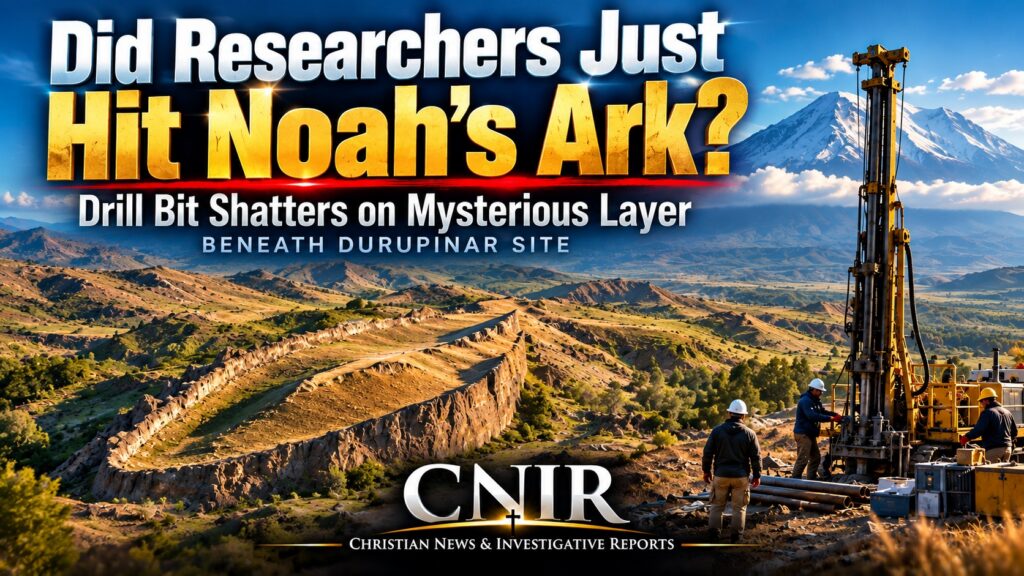
DOĞUBAYAZIT, Türkiye — A new scientific investigation at the controversial Durupınar Formation near Mount Ararat has taken an intriguing turn after researchers reported that a drill bit shattered upon striking an unusually hard underground layer.
The discovery does not prove that Noah’s Ark has been found. However, researchers say samples from the mysterious layer could help determine what lies beneath the boat-shaped formation that has fascinated archaeologists, geologists and Bible researchers for decades.
Drilling Goes Beneath the Formation
The 2026 investigation, directed by archaeology professor Dr. Cenker Atila of Sivas Cumhuriyet University, is conducting permitted core drilling inside and outside the approximately 157-meter — 515-foot — formation.

Researchers are recovering samples from depths reaching approximately 18 meters, or nearly 60 feet. The project received authorization from Turkish government agencies and is expected to continue with laboratory analysis and additional research.
But one particular drilling location has captured international attention.
According to Andrew Jones, vice president of the Noah’s Ark Research Project, drilling approximately four to five meters beneath the surface suddenly encountered an extremely resistant layer.
The material was reportedly hard enough to break the drill bit.
Could It Be Petrified Wood?
Researchers have raised the possibility that the drill encountered petrified or highly mineralized wood, but that identification has not been scientifically confirmed.
Jones said third-party laboratory testing will be used to investigate the material. The team plans to analyze recovered cores for composition, organic content, mineralogy and stratigraphy.
That distinction is critical.
At this stage, researchers have reported encountering an unusually hard layer. They have not announced the discovery of petrified wood from Noah’s Ark.
Independent reporting has likewise noted that the expedition’s claims concerning the hard layer have not yet been independently confirmed.
A Mystery Dating Back Decades
The Durupınar Formation was identified in aerial photographs in 1959 by Turkish Army Captain İlhan Durupınar.
Its unusual boat-like shape and approximately 515-foot length have helped fuel decades of speculation that the formation could somehow be associated with the vessel described in Genesis.
Recent investigations have employed ground-penetrating radar, electrical resistivity tomography, LiDAR, soil analysis and now core drilling.
Previous surveys have identified linear subsurface features, right-angle patterns and other anomalies that researchers say warrant further investigation. Soil testing also reportedly found substantially higher organic material in samples taken from inside the formation compared with samples outside it.
None of those findings, however, independently establishes that the formation is man-made.
Evidence Must Come First
Even the project’s official Turkish research website emphasizes scientific caution.
The organization describes the available data as “suggestive, not conclusive” and explicitly states that the research project is not claiming proof that the formation is Noah’s Ark.
That makes the laboratory testing potentially one of the most important stages of the investigation.
For Christians familiar with Genesis 8:4 — which states that the Ark rested upon the “mountains of Ararat” — the Durupınar investigation will undoubtedly attract considerable interest.
But for now, the broken drill bit represents a question, not an answer.
What researchers struck several meters beneath Durupınar remains unknown.
If laboratory analysis identifies the material as mineralized or petrified wood, investigators would then face an even bigger question:
How did it get there?
CNIR Sources
Noah’s Ark Scans Türkiye — Official 2026 research project, methodology and scientific-caution documentation.
Noah’s Ark Scans / GlobeNewswire — September 23, 2026 — Announcement describing the core drilling, broken drill bit and planned third-party laboratory analysis.
KRLD/Audacy — September 24, 2026 — Independent coverage noting that petrified or mineralized wood is currently a possibility rather than an established identification.