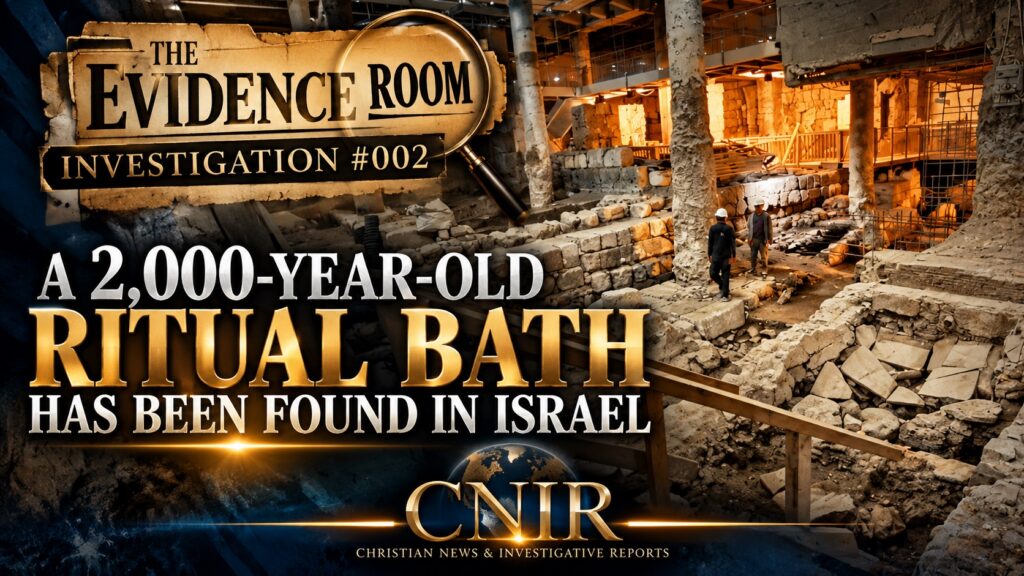
A 2,000-Year-Old Ritual Bath Has Been Found in Israel—What Does It Tell Us About the World of the New Testament?
KIRYAT GAT, Israel — Archaeologists in southern Israel have uncovered something that brings the religious world surrounding the New Testament into sharper focus: a massive Jewish ritual bath dating back roughly 2,000 years.
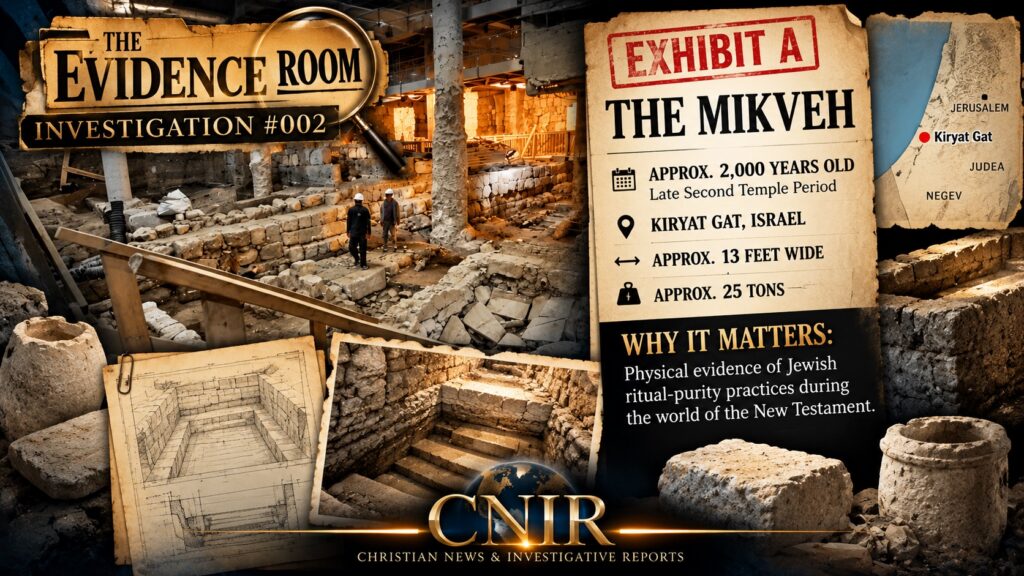
The ancient mikveh, discovered during archaeological excavations ahead of construction in the Carmei Gat neighborhood of Kiryat Gat, dates to the late Second Temple period—the broad historical era in which Jesus of Nazareth lived and the New Testament story unfolded.
For THE EVIDENCE ROOM — INVESTIGATION #002, CNIR examines what was actually discovered—and what the archaeology can and cannot tell us about the biblical world.
A 25-Ton Discovery
According to the Israel Antiquities Authority, the plastered ritual bath is approximately 13 feet wide and weighs about 25 tons.
Its size created an extraordinary preservation challenge. Conservators excavated around the structure, reinforced it with steel supports and used a crane capable of lifting 300 tons to remove the ancient bath intact. It was transported temporarily for protection while development continues and is expected eventually to return to Kiryat Gat for public display.
But the engineering operation isn’t what makes the discovery most important.
The mikveh provides evidence of a Jewish community living in an area where archaeologists previously did not know such a settlement existed.
IAA excavation directors said this is the first known Jewish settlement from this period discovered in this particular zone between the Judean Lowlands and northern Negev.
What Exactly Is a Mikveh?
A mikveh is a Jewish ritual immersion pool associated with purification.
That distinction matters. This was not simply an ancient bathtub or swimming pool.
Jewish ritual purity has deep biblical roots. The books of Leviticus and Numbers contain numerous laws dealing with ritual cleanliness, impurity and washing. By the Second Temple period, specially constructed immersion pools had become an important feature of Jewish religious life. Archaeologists have uncovered mikva’ot throughout ancient Judea, including around Jerusalem and near the Temple Mount.
That means archaeology is uncovering physical structures connected to religious practices that formed part of the cultural environment encountered throughout the New Testament.
The New Testament Connection
The discovery does not prove that Jesus visited this particular mikveh, nor have archaeologists connected the Kiryat Gat settlement directly to Jesus or one of His disciples.
That would go beyond the evidence.
But the discovery does something historically significant.
It gives us another physical window into Jewish life during the period in which the New Testament emerged.
The Gospel of John, for example, opens part of Jesus’ ministry in a world where ritual purification was already familiar:
“And there were set there six waterpots of stone, after the manner of the purifying of the Jews…” — John 2:6, KJV
Archaeologists at the Kiryat Gat settlement also discovered stone measuring vessels. Such stone vessels are strongly associated with Jewish ritual-purity practices during the Second Temple period because stone was understood differently from pottery regarding ritual impurity.
Suddenly, details modern Bible readers may pass over are placed within an identifiable archaeological culture.
A Jewish Community We Didn’t Know Existed
Perhaps the most significant aspect of the discovery is its location.
Jewish settlements from the Roman period are well documented elsewhere in the Judean Lowlands. But according to the excavation directors, no comparable Jewish settlement had previously been identified in this transitional area toward the northern Negev.
The mikveh and accompanying artifacts changed that picture.
Evidence from the site indicates the Jewish settlement apparently continued beyond the destruction of Jerusalem in 70 CE before being abandoned around the period of the Bar Kokhba Revolt in the second century CE. Centuries later, the location was inhabited again during the Byzantine period by a different population.
This makes the discovery more than an isolated religious installation.
It points toward an entire Jewish community whose existence had essentially disappeared from the known historical landscape.
Archaeology and the Biblical World
Archaeology cannot prove every theological claim of Christianity.
That isn’t its purpose.
What archaeology can do is test historical settings, uncover ancient communities and reveal whether customs, buildings, objects and practices described in ancient texts correspond to the material world of their period.
In this case, the evidence is tangible:
A Jewish settlement.
Stone vessels.
A ritual purification bath.
A community dating back approximately 2,000 years.
And all of it belongs to the wider historical world in which the New Testament arose.
Another Second Temple-period mikveh discovered near Jerusalem’s Western Wall and reported in 2026 likewise demonstrated how widespread ritual-purity practices could be around the Temple. Archaeologists have uncovered numerous ritual baths associated with Jewish pilgrimage and religious life from this era.
THE EVIDENCE ROOM VERDICT
The Kiryat Gat discovery does not prove the New Testament or establish the truth of Christianity by itself.
Its importance is more precise—and perhaps more interesting.
It provides physical archaeological evidence of the Jewish religious culture that existed during the New Testament era.
Nearly 2,000 years after people descended those steps into the water, the structure remains.
For Christians reading descriptions of purification, stone vessels, Jerusalem pilgrimages and Jewish religious customs in the New Testament, archaeology is helping reconstruct the physical world behind those words.
The Bible describes an ancient world. Archaeology keeps uncovering pieces of it.
And that is why this discovery belongs inside THE EVIDENCE ROOM.
CNIR — Christian News & Investigative Reports
THE EVIDENCE ROOM — INVESTIGATION #002
Sources
Israel Antiquities Authority reporting on the Kiryat Gat excavation and conservation project; Biblical Archaeology Review/Biblical Archaeology Society; The Times of Israel; The Jerusalem Post; Associates for Biblical Research.
Disclaimer: The information presented in this article is for informational and educational purposes only. Readers are advised to conduct thorough research before making any decisions. Source: Christian News & Investigative Reports (CNIR) — cnirbc.com Reporting the headline. Investigating the facts