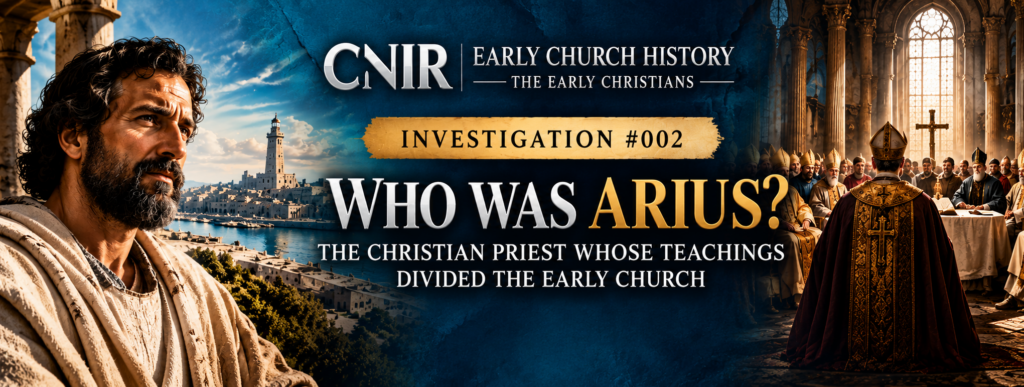
CNIR | EARLY CHURCH HISTORY — THE EARLY CHRISTIANS
INVESTIGATION #002 | HISTORICAL INVESTIGATION
The theological dispute surrounding Arius challenged the early church’s understanding of Jesus Christ and helped bring about the historic Council of Nicaea in AD 325.

A Controversy That Shook Early Christianity
More than 1,700 years ago, a Christian priest named Arius became the center of one of the most influential theological controversies in church history. Serving in Alexandria, Egypt, Arius challenged the belief that Jesus Christ had existed eternally with God the Father. His teachings sparked widespread disagreement among Christian leaders, ultimately contributing to the Council of Nicaea in AD 325. The controversy raised a question that would shape Christian doctrine for centuries: Was Jesus Christ eternally divine, or did the Son receive his existence from the Father before creation?
Who Was Arius, and What Did He Believe?
Arius was a presbyter, or priest, serving in Alexandria during the early fourth century. He taught that God the Father alone was without beginning and that the Son came into existence through the Father’s will before the creation of the universe. Although Arius considered Jesus uniquely exalted and greater than all created beings, he denied that the Son was coeternal with the Father. His position directly conflicted with the teachings of Alexander, the bishop of Alexandria, who defended Christ’s eternal divine identity. The disagreement soon spread beyond Egypt and attracted supporters throughout the eastern Roman Empire.
Why Did Early Church Leaders Reject Arius?
Bishop Alexander and other Christian leaders argued that Arius’s teaching undermined the divine nature of Jesus Christ. They maintained that the Son had not come into existence at a particular moment but existed eternally with the Father. Around AD 320–321, a regional council in Alexandria condemned Arius’s teachings. However, the controversy continued as influential bishops defended competing interpretations of Scripture. The dispute revealed serious theological disagreements within Christianity, even after centuries of Christian worship and teaching.
Did Emperor Constantine Decide That Jesus Was God?
A persistent historical misconception claims that Emperor Constantine invented the belief that Jesus Christ was God. Historical evidence does not support that claim. Christians had described Jesus in divine terms and worshiped him long before Constantine’s reign. Nevertheless, Constantine became concerned that the controversy threatened unity within the Roman Empire. In AD 325, he convened bishops at Nicaea, located in present-day Türkiye. The council affirmed that the Son was homoousios, a Greek term meaning “of the same substance” or essence as the Father. This declaration rejected Arius’s position that the Son was not eternal.
Did Christians Believe Jesus Was God Before Nicaea?
Early Christian documents provide important evidence that belief in Jesus’ divinity existed long before AD 325. Ignatius of Antioch, writing in the early second century, referred to Jesus Christ as God. Justin Martyr, another early Christian writer, defended Christ’s divine identity while explaining the relationship between the Father and Son. Although early Christian theologians did not always use identical terminology, their writings demonstrate that Christ’s divine identity was being discussed centuries before the Council of Nicaea. These historical records contradict the assertion that Constantine introduced belief in Jesus’ divinity.
What Does Scripture Reveal About Jesus Christ?
The debate surrounding Arius centered on competing interpretations of biblical passages. John 1:1 (KJV) declares: “In the beginning was the Word, and the Word was with God, and the Word was God.” John 1:3 attributes creation to the Word, while John 1:14 declares that the Word became flesh. Colossians 1:16–17 also describes Christ’s relationship to creation and his existence before all things. Defenders of the Nicene position interpreted these passages as evidence of Christ’s eternal divine nature. Arius and his supporters understood the relationship between the Father and Son differently.
CNIR Investigative Findings: What Does History Establish?
The historical record supports several important conclusions about the controversy surrounding Arius. First, Christian belief in Jesus’ divinity existed before the Council of Nicaea. Second, Arius’s teachings challenged an understanding of Christ’s eternal identity already defended by influential church leaders. Third, the Council of Nicaea did not invent the doctrine of Christ’s divinity. Rather, it formally articulated a theological position in response to competing interpretations. Although Arius was condemned in AD 325, the controversy continued for decades and contributed to further doctrinal developments, including the Council of Constantinople in AD 381.
CNIR’s investigative conclusion: The controversy surrounding Arius demonstrates that the early church was debating how to understand and express the divine identity of Jesus Christ—not witnessing an emperor invent Christianity’s belief in a divine Savior.
COMING NEXT | EARLY CHURCH HISTORY — INVESTIGATION #003
Ignatius of Antioch: Did Christians Believe Jesus Was God Before the Council of Nicaea?
CNIR — Reporting the headline. Investigating the facts.
Christian News & Investigative Reports – cnirbc.com
Disclaimer: This historical investigation is presented for informational and educational purposes. Historical interpretations are distinguished from documented events wherever possible.