CNIR | THE EVIDENCE ROOM — BIBLICAL ARCHAEOLOGY SERIES
For more than 2,600 years, the fate of one of the Bible’s most sacred objects has remained a mystery. From Jerusalem to Ethiopia, ancient traditions offer competing explanations. But what does the biblical and historical evidence actually reveal?
The Biblical Mystery That Remains Unsolved
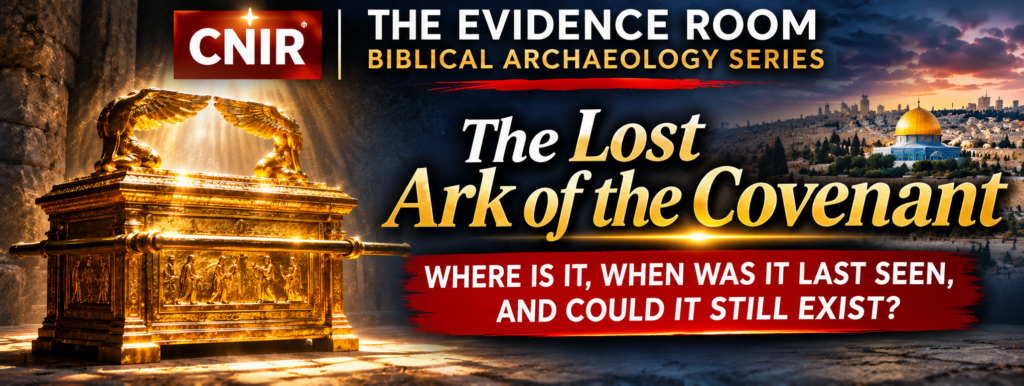
The Ark of the Covenant remains one of the most intriguing mysteries in biblical archaeology. According to Scripture, the sacred chest was constructed under Moses’ direction, covered with gold, and associated with God’s covenant with Israel.
Exodus 25:10–22 describes its construction, including the mercy seat and two cherubim positioned above it.
The Ark eventually rested inside the Most Holy Place of Solomon’s Temple in Jerusalem. However, its documented history becomes uncertain before the Babylonian destruction of the Temple in 586 BC.
To this day, no archaeological discovery has conclusively established the location of the original Ark.
When Was the Ark of the Covenant Last Seen?
One of the clearest biblical descriptions of the Ark’s location appears in 1 Kings 8:6, during the dedication of Solomon’s Temple in the tenth century BC.
A later reference appears in 2 Chronicles 35:3, during King Josiah’s reign in the seventh century BC.
Josiah instructed the Levites:
“Put the holy ark in the house which Solomon the son of David king of Israel did build.” — 2 Chronicles 35:3 (KJV)
This passage is particularly significant because it places the Ark within the religious setting of Josiah’s reign, although it does not explicitly record the completion of his instruction.
When Babylonian forces destroyed Jerusalem’s Temple in 586 BC, the biblical accounts described numerous sacred objects being removed. However, the Ark was not specifically identified among them.
Its fate remains unknown.
Four Possible Locations of the Lost Ark
1. Jerusalem: Could the Ark Be Hidden Beneath the Temple Mount?
One longstanding theory suggests that the Ark was concealed somewhere beneath or near the Temple Mount before the Babylonian invasion.
Later Jewish traditions describe the Ark being hidden during Josiah’s reign, possibly in a concealed chamber associated with the Temple.
Because Jerusalem was the Ark’s last clearly documented setting, this theory has a direct geographical connection to the biblical record.
However, no independently authenticated archaeological discovery has established that the Ark remains beneath the Temple Mount.
2. Mount Nebo: Did the Prophet Jeremiah Hide the Ark?
An ancient account in 2 Maccabees 2:4–8 describes Jeremiah taking the Ark to a mountain associated with Moses and concealing it inside a cave.
Mount Nebo, located in modern-day Jordan, is traditionally associated with Moses viewing the Promised Land.
According to the account, the hiding place would remain unknown until God gathered His people again.
Second Maccabees is included in Catholic and Orthodox biblical traditions but is not part of the Protestant canon.
Although this account preserves an important ancient tradition, it does not provide archaeological proof that Jeremiah hid the Ark there.
3. Ethiopia: Is the Ark Being Guarded in Axum?
One of the most enduring claims concerning the Ark comes from Ethiopia.
The Ethiopian Orthodox Tewahedo Church maintains a tradition that the Ark is preserved in Axum, associated with the Church of Our Lady Mary of Zion.
The tradition connects the Ark’s arrival in Ethiopia with Menelik I, traditionally described as the son of Solomon and the Queen of Sheba.
However, the object claimed to be the Ark has not been made available for independent scientific authentication.
The Ethiopian account remains an important religious tradition rather than a verified archaeological discovery.
4. Babylon: Was the Ark Taken or Destroyed?
Another possibility is that the Ark was captured, destroyed, or lost during the Babylonian conquest.
Second Kings 25 describes the removal of valuable objects from Jerusalem’s Temple.
However, the Ark is not specifically mentioned among the captured treasures.
Its absence has prompted several theories: it may have been hidden before the invasion, removed without being recorded, or destroyed during the conflict.
None of these explanations has been conclusively established.
Could the Ark Have Disappeared Before the Babylonian Invasion?
Some researchers have considered whether the Ark disappeared before Jerusalem fell.
Throughout Judah’s history, the Temple experienced periods of religious corruption, political instability, and foreign influence.
It is possible that the Ark was removed during an earlier period and never returned.
However, the surviving evidence does not establish when or how such a disappearance occurred.
What Does the Prophet Jeremiah Reveal About the Ark?
Jeremiah 3:16 introduces another important dimension to the mystery.
The prophet describes a future time when the Ark would no longer occupy the same place in Israel’s religious life.
The passage states:
“Neither shall it come to mind: neither shall they remember it; neither shall they visit it; neither shall that be done any more.” — Jeremiah 3:16 (KJV)
This prophecy raises an important theological question: Would the Ark eventually become unnecessary as a symbol of God’s presence among His people?
Although the passage does not explain what physically happened to the Ark, it offers an important biblical perspective on its significance.
The Evidence Room: What Can History Actually Establish?
The available biblical and historical evidence supports three important observations.
First, the Ark occupied a central place in ancient Israel’s worship and was placed inside Solomon’s Temple according to Scripture.
Second, the last explicit Old Testament reference to the Ark occurs during Josiah’s reign, before the Babylonian destruction of Jerusalem.
Third, none of the proposed locations—including Jerusalem, Mount Nebo, Ethiopia, or Babylon—has produced independently authenticated archaeological evidence es