CNIR | THE EVIDENCE ROOM — BIBLICAL ARCHAEOLOGY | NOVEMBER 28, 2026
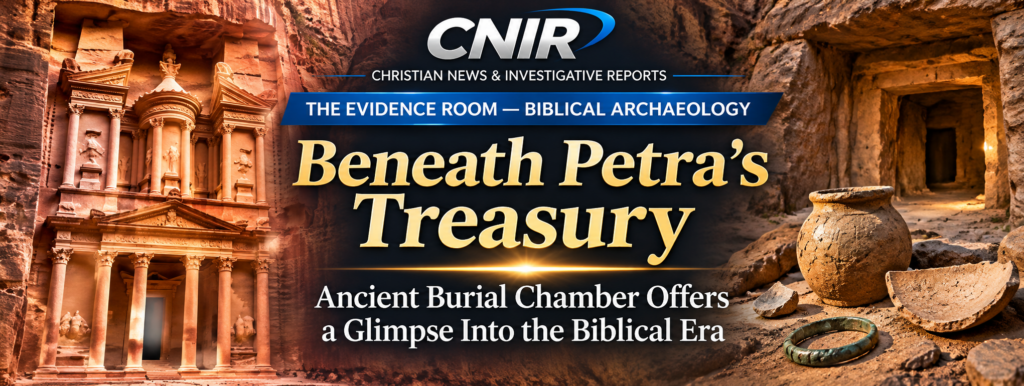
Archaeologists investigating the ancient city of Petra, Jordan, uncovered a hidden burial chamber beneath its internationally recognized Treasury, revealing human remains and artifacts that offer insight into the civilization that flourished during the New Testament period.
Announced in October 2024, the discovery provides researchers with an opportunity to better understand the burial practices, culture and history of the Nabataean Kingdom, whose rulers included a king mentioned in the Bible.
An Ancient Chamber Beneath Petra
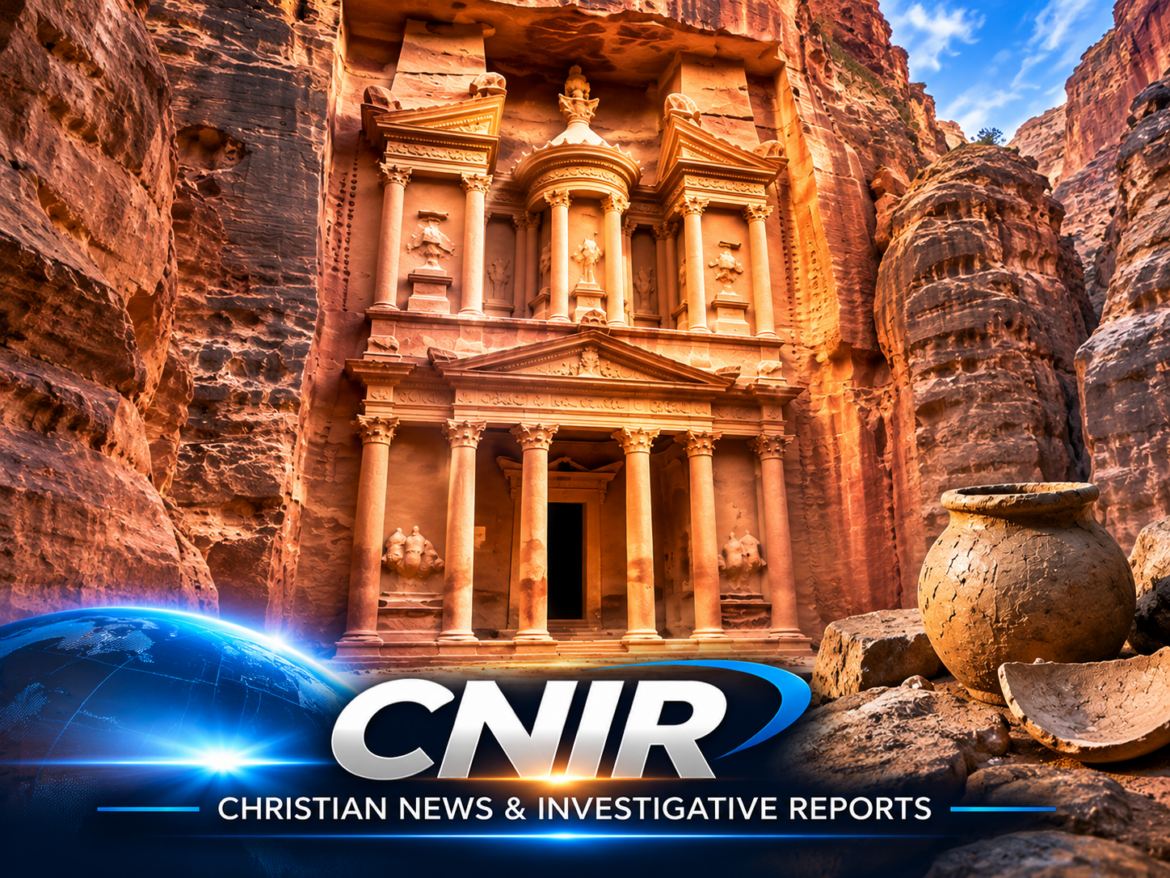
The excavation took place beneath Al-Khazneh, commonly known as the Treasury, a monumental structure carved into Petra’s sandstone cliffs.
Researchers discovered the skeletal remains of 12 individuals alongside ancient burial objects. The findings included ceramic and metal artifacts that could help archaeologists better understand Nabataean society.
Unlike many previously disturbed tombs in Petra, the chamber contained human remains and associated burial materials, providing valuable evidence for archaeological investigation.
New Research Provides Important Historical Evidence
On November 5, 2026, the American Center of Research (ACOR) published an archaeological update concerning the excavation of the burial chamber, officially designated Tomb 62c.
Analysis of materials recovered during the excavation has tentatively placed the construction of Petra’s Treasury between 9 and 1 BC, during the reign of Nabataean King Aretas IV.
However, archaeological records reveal that the tomb was initially identified in 2003 and investigated in 2005. The 2024 expedition continued that earlier research using modern scientific equipment and excavation methods.
The updated findings could help resolve longstanding questions regarding the construction and original purpose of the Treasury.
The Biblical Connection: King Aretas IV
Perhaps the most intriguing aspect of the archaeological investigation for biblical scholars is its historical association with King Aretas IV, who ruled the Nabataean Kingdom from approximately 9 BC to AD 40.
The Apostle Paul references Aretas in his second letter to the Corinthians, describing an incident in Damascus.
2 Corinthians 11:32–33 (KJV)
In Damascus the governor under Aretas the king kept the city of the Damascenes with a garrison, desirous to apprehend me:
And through a window in a basket was I let down by the wall, and escaped his hands.
The biblical passage provides a historical reference to the political authority of the Nabataean ruler during the early years of Christianity.
Although archaeologists have not established a direct connection between the burial chamber and the Apostle Paul, the excavation offers additional historical context surrounding a kingdom mentioned in Scripture.
Separating Archaeological Evidence From Speculation
International attention intensified after one of the recovered ceramic objects appeared to resemble a chalice, prompting comparisons to the legendary Holy Grail.
Scientific examination, however, identified the object as a fragment of an ancient ceramic jug.
Researchers have not established that the chamber contains the remains of King Aretas IV or any other individual identified in Scripture.
These distinctions remain important when evaluating archaeological discoveries associated with biblical history.
Uncovering the World of the Bible
As researchers continue examining Petra’s archaeological remains, their findings may provide a clearer understanding of the people, cultures and political powers that existed during the early Christian period.
The investigation represents another opportunity to examine the historical setting of Scripture through documented archaeological evidence.
While questions surrounding the Treasury remain, the continuing research demonstrates how ancient history can illuminate the world in which the events of the New Testament unfolded.
Source verification — Editorial reference
American Center of Research: Petra Treasury Tomb 62c Excavation — November 5, 2026
University of St Andrews: Official archaeological research announcement — October 15, 2024.
American Center of Research: Clarification of previous excavations — November 17, 2024.
Biblical reference: 2 Corinthians 11:32–33 (KJV).
Editorial clarification: The original tomb was identified in 2003, not 2024 or 2026. The November 2026 research update is the current newsworthy development. This distinction has been incorporated into the article to maintain CNIR’s reporting accuracy.
Christian News & Investigative Reports (CNIR)
Reporting the headline. Investigating the facts.