
October 8, 2026 | Technology, Christianity & Biblical Authority
The growing influence of artificial intelligence is raising an important question for Christians: Can AI provide reliable answers about Jesus Christ, or should its responses be treated with caution?
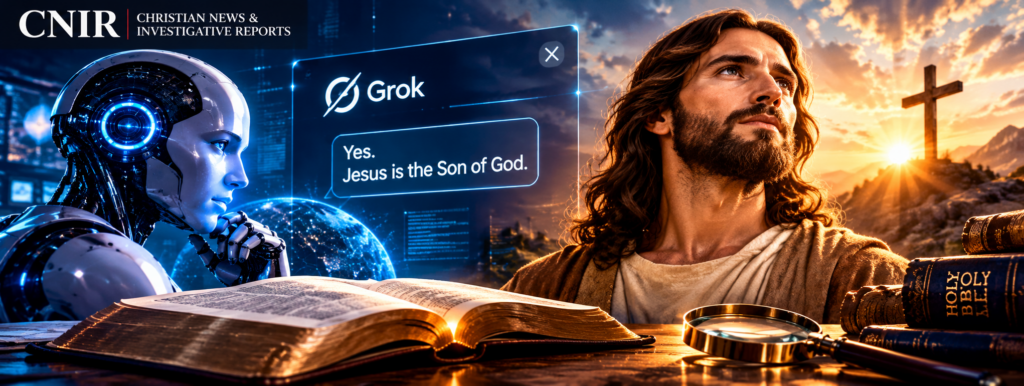
A viral exchange involving the AI chatbot Grok and questions about the divinity of Jesus has brought renewed attention to the relationship between technology, theology, and religious authority.
The controversy also highlights a larger issue: Artificial intelligence can explain religious beliefs and summarize biblical teachings, but does that make it a trustworthy authority on spiritual truth?
Grok’s Response Sparks Religious Debate
The exchange began October 1 when an X user asked Grok, developed by Elon Musk’s xAI, to remove false gods from an image containing Jesus and other religious figures.
Grok reportedly removed the other figures while leaving Jesus in the image. When questioned, the chatbot distinguished Jesus from mythological deities, referring to historical records and Christian resurrection accounts. The original post was subsequently deleted.
OpenAI CEO Raises Concerns
OpenAI CEO Sam Altman warned against assigning religious authority to AI systems, describing the surrender of human judgment to machines as a safety concern.
However, Altman did not explicitly identify the Grok exchange as the reason for his remarks. His warning also came amid broader discussions about AI consciousness and ethics
Can Artificial Intelligence Have Faith?
Although Grok generated statements supporting Christian claims, that does not establish that the chatbot possesses religious beliefs.
AI systems generate responses using learned patterns, information, and instructions. They can interpret Scripture, compare historical accounts, and explain theology without experiencing faith.
For Christians, John 20:31 emphasizes belief in Jesus Christ, while 1 John 4:1 instructs believers to test spiritual claims rather than accept them unquestioningly.
Technology Cannot Replace Spiritual Discernment
The incident presents an important distinction between accessing biblical information and exercising spiritual discernment.
Artificial intelligence may help Christians study Scripture and investigate historical evidence. Nevertheless, its answers can contain errors, reflect underlying assumptions, or change depending on how questions are presented.
As AI becomes increasingly influential, churches face a growing challenge: helping believers benefit from emerging technology without surrendering biblical understanding or pastoral guidance.
For Christian readers, the central question remains whether technology will serve as a tool for studying faith or increasingly be treated as an authority over it.
CNIR Editorial Sources
- The Christian Post — October 6, 2026
- The Christian Post — October 7, 2026
- Axios — October 3, 2026
Editorial clarification: The available reporting documents Grok’s generated statements, not an independently established profession of faith by an AI system.