CNIR SPECIAL REPORT — PART ONE
Wars are expanding. Food insecurity remains severe. Disease outbreaks continue to challenge health systems. Powerful earthquakes have struck multiple regions. Millions of Christians face persecution.
For Christians who take biblical prophecy seriously, the question is becoming increasingly difficult to ignore: Are we witnessing ordinary cycles of human history—or the developing global conditions Jesus described as the “beginning of sorrows”?
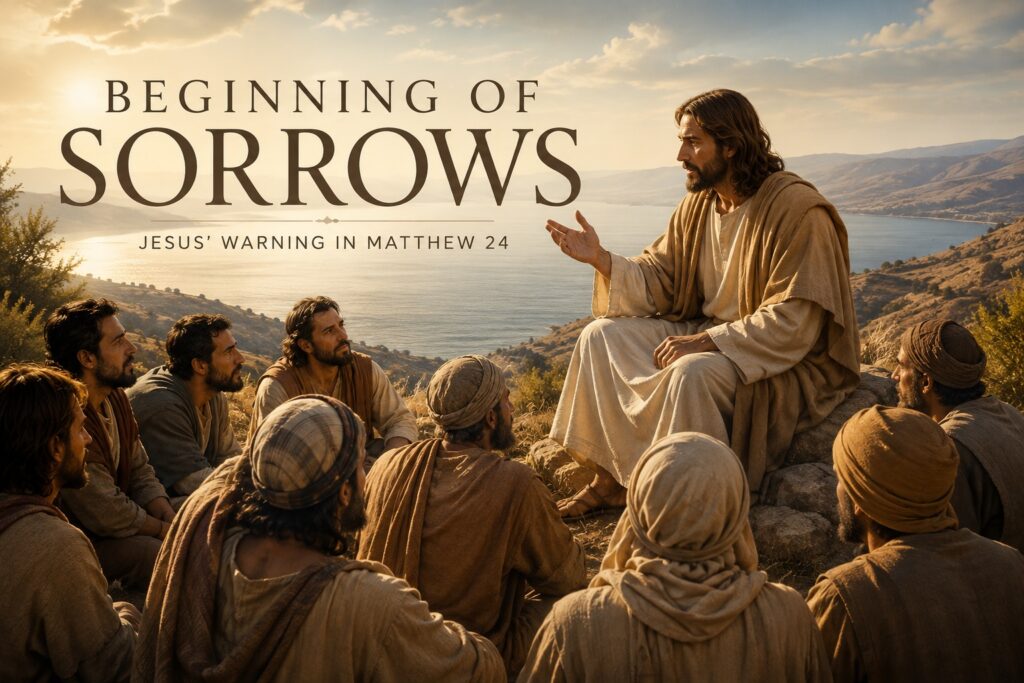
Jesus gave that warning nearly 2,000 years ago while describing events surrounding the end of the age.
What Scripture Actually Says
In Matthew 24, Jesus warned His disciples against deception before describing a period of international conflict and global distress:
“And ye shall hear of wars and rumours of wars: see that ye be not troubled: for all these things must come to pass, but the end is not yet.” — Matthew 24:6 KJV
He continued:
“For nation shall rise against nation, and kingdom against kingdom: and there shall be famines, and pestilences, and earthquakes, in divers places. All these are the beginning of sorrows.” — Matthew 24:7–8 KJV
The expression translated “sorrows” comes from the Greek ōdin, a term associated with the pains of childbirth.
That imagery is significant.
Labor pains do not represent the conclusion of pregnancy. They signal that a process has entered a new stage and that something greater is approaching.
Jesus also warned that religious deception, persecution, betrayal, false prophets and increasing iniquity would characterize this period (Matthew 24:4–12).
What Is Happening Today?
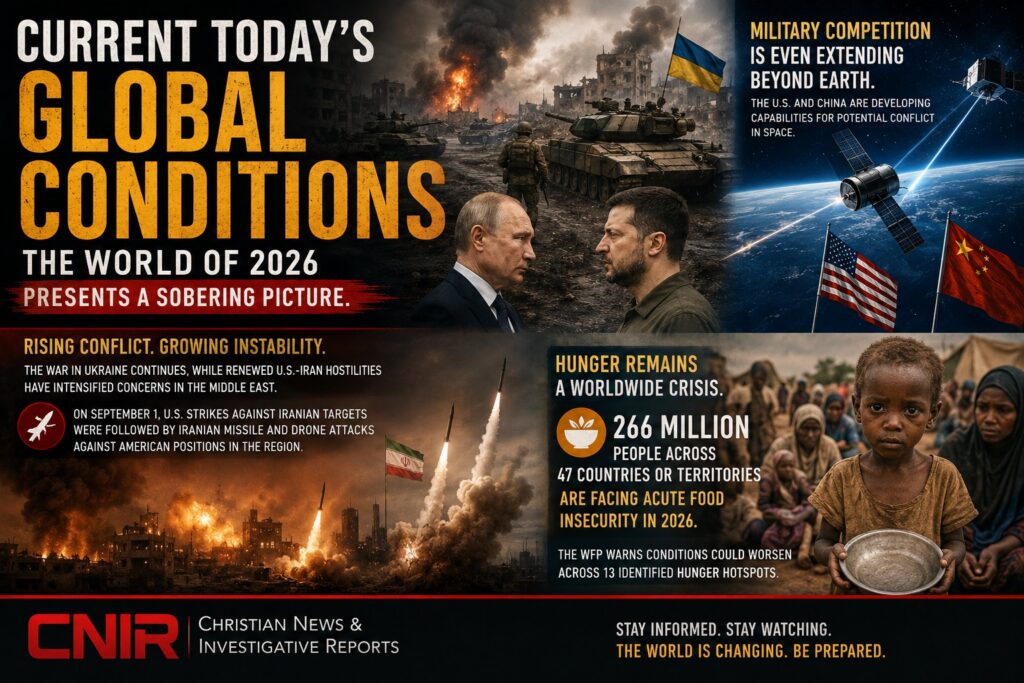
The world of 2026 presents a sobering picture.
Armed conflict remains a major source of international instability. The war involving Russia and Ukraine continues, while renewed U.S.-Iran hostilities have again intensified concerns surrounding the Middle East. On September 1, U.S. strikes against Iranian targets were followed by Iranian missile and drone attacks against American positions in the region.
Military competition is even extending beyond Earth. Reuters reported September 2 that the United States and China are developing capabilities for potential conflict in space, including maneuverable satellites, jamming systems and other counter-space technologies.
Meanwhile, hunger remains a worldwide crisis. The World Food Programme says as many as 266 million people across 47 countries or territories are facing acute food insecurity in 2026. Its June-to-November outlook warned that conditions could worsen across 13 identified hunger hotspots.
Disease has not disappeared from the global picture either. Recent World Health Organization reporting has tracked public-health emergencies including mpox and cholera, while an Ebola outbreak caused by Bundibugyo virus has spread across multiple health zones and provinces.
The earth itself has also produced powerful seismic events. USGS records show a magnitude 7.8 earthquake in the Philippines in June, 7.4 in Colombia in August and 7.7 near Indonesia in August 2026.
Christian persecution remains another striking reality. Open Doors’ 2026 World Watch List estimates that more than 388 million Christians experience high levels of persecution or discrimination, with more than 315 million living in the 50 countries classified as experiencing very high or extreme persecution.
None of these developments exists in isolation. And that is precisely where the prophetic discussion becomes more compelling.
The Question May Be Convergence
Wars are not new. Neither are earthquakes, famine, disease or persecution.
What deserves attention is the possibility of convergence—multiple conditions identified by Jesus existing simultaneously across an increasingly interconnected world.
Jesus did not tell His followers that every war meant the end had arrived. In fact, He explicitly said, “the end is not yet.”
But He also told them to recognize the conditions surrounding the approaching end.
The beginning of sorrows, therefore, may be better understood not as one catastrophic event, but as the opening contractions of a much larger prophetic sequence.
What Could Possibly Happen Next?
This is where today’s headlines could become tomorrow’s defining events.
If current conflicts widen, energy supplies could be disrupted. Food and transportation costs could rise. Economic pressure could intensify. Additional wars could destabilize governments. Disease outbreaks or natural disasters could place further pressure on already strained societies.
And populations exhausted by instability could increasingly demand something governments have repeatedly promised but struggled to deliver:
Peace. Security. Stability.
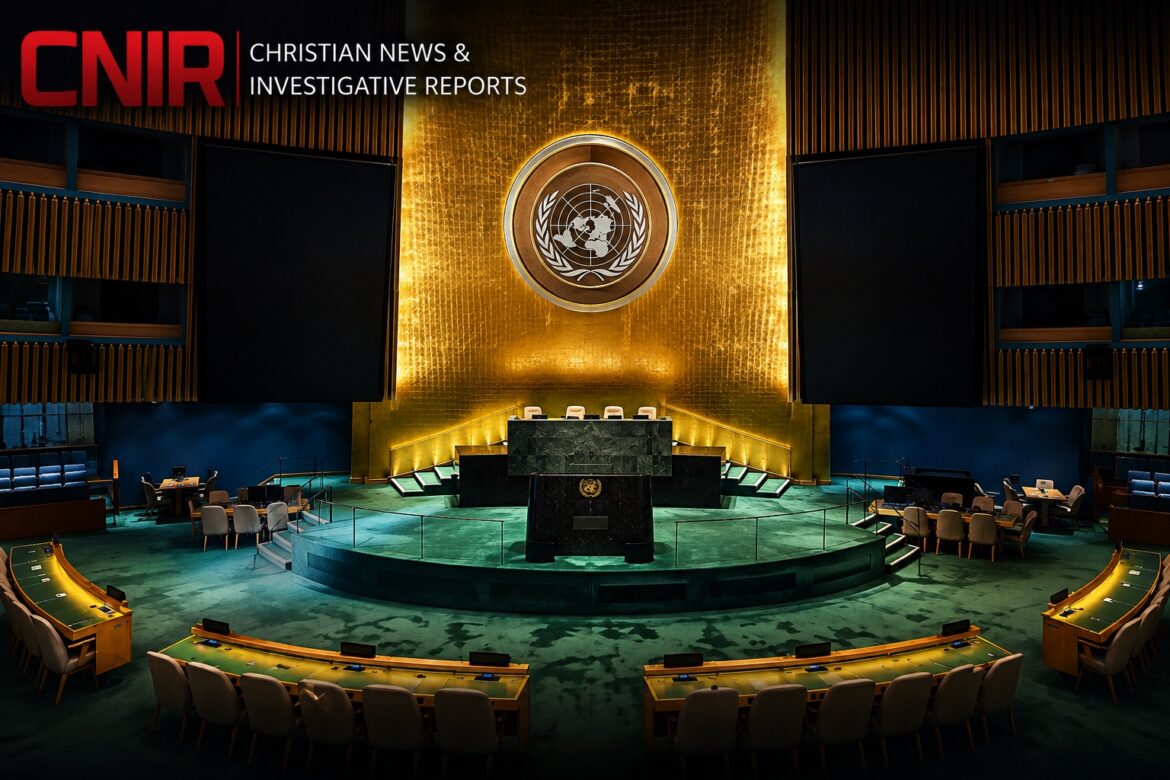
The world could consequently move toward greater international cooperation, stronger centralized mechanisms for responding to crises, expanded digital identification, increasingly interconnected financial systems and political leaders promising solutions that transcend national boundaries.
None of that requires a conspiracy.
Crisis naturally creates pressure for solutions.
But Bible prophecy gives Christians another reason to pay attention. Scripture describes a future period in which extraordinary political authority, economic control and spiritual deception eventually converge under a powerful world ruler (Daniel 7; 2 Thessalonians 2; Revelation 13).
The question is not whether today’s institutions are secretly fulfilling Revelation 13.
The more provocative question is this:
Could the crises developing today eventually create the conditions in which the world becomes willing to accept what Bible prophecy says is coming tomorrow?
If so, the “beginning of sorrows” may be about far more than earthquakes, wars and famine.
It may describe a world being progressively prepared for the next stage.
And for Christians who hold to the pre-tribulation interpretation of biblical prophecy, that raises an even greater question.
Before the Antichrist rises to global prominence, could the next major prophetic event involve the sudden removal of the Church?
Editorial Note
This article is intended to encourage biblical discussion—not to criticize any individual pastor, church, or denomination. CNIR affirms that Scripture honors faithful spiritual leaders while also emphasizing the importance of mentoring and preparing the next generation. Our hope is that this conversation inspires churches to remain biblically faithful, spiritually healthy, and ready for the future. This article was created with AI assistance and curated by CNIR Staff for accuracy and editorial standards. Source: Christian News & Investigative Reports (CNIR) — cnirbc.com