
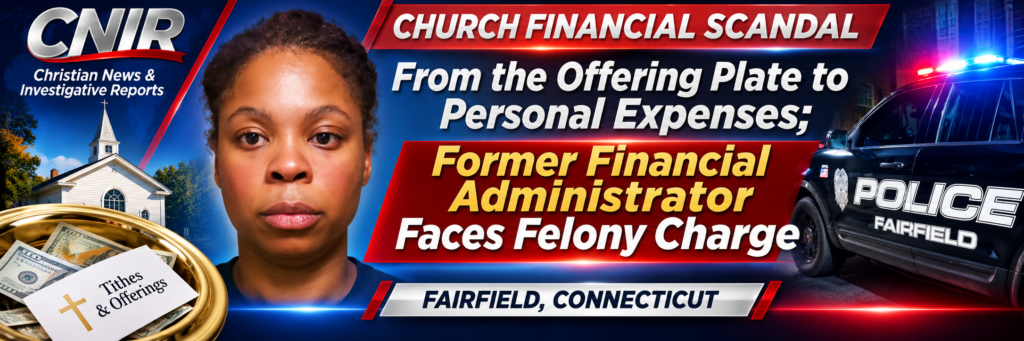
FAIRFIELD, Connecticut — A former church financial administrator is facing felony charges after authorities accused her of diverting more than $255,000 from a Connecticut congregation over several years, raising serious concerns about financial accountability and the protection of charitable donations.
Diane Devlin, 42, of Fairfield, has been charged with first-degree larceny following an investigation into missing funds at Southern Connecticut Church of Christ.
According to Fairfield police and details contained in an arrest warrant, investigators identified approximately $255,054.41 in allegedly misappropriated church funds, with unauthorized transactions dating back to 2021.
Church Financial Investigation Uncovers Missing Funds
The investigation began in June 2025 when the church treasurer contacted Fairfield police regarding approximately $18,000 in suspected unauthorized transactions.
Although the treasurer initially declined to pursue a formal police investigation, a subsequent examination of church financial records reportedly uncovered substantially greater discrepancies.
By November 2025, church officials had identified more than $200,000 in additional suspected diversions and requested police involvement.
Investigators subsequently examined church banking records, financial transactions and documents associated with Devlin’s personal accounts.
According to the arrest warrant, the disputed transactions included payments toward personal credit card balances, restaurant expenses and purchases unrelated to church operations.
Authorities also alleged that church funds were transferred to D3 Medical Management, a business in which Devlin was identified as a principal.
Alleged Admissions Reveal How the Financial Misconduct Escalated
One of the most significant developments involves statements attributed to Devlin in communications with church leadership.
According to the warrant, Devlin initially attributed financial discrepancies to accounting software problems and characterized certain personal expenditures as accidental.
However, investigators reported that church leaders subsequently obtained statements in which Devlin acknowledged falsifying financial documents.
During a June 2025 meeting, Devlin allegedly admitted manipulating church records to conceal unauthorized transactions.
In a subsequent written exchange with a church leader, she reportedly described how the conduct escalated over time.
The warrant attributes this statement to Devlin:
“Over time, borrowing became taking.”
She also reportedly acknowledged concealing her actions and allowing the misconduct to continue, describing the progression in religious terms.
“And because I didn’t stop, the sin grew,” she wrote, according to the warrant.
These statements are allegations documented in the criminal investigation and have not been established as findings by a court.
Former Administrator Faces Felony Larceny Charge
Devlin resigned from her position in May 2025, before completion of a financial audit covering five years of church activity.
She surrendered to Fairfield police on October 13, 2026, and was charged with first-degree larceny.
Authorities reported that she was released after posting a $25,000 bond.
Her next scheduled court appearance is November 20, 2026, at Connecticut Superior Court in Bridgeport.
Whether the congregation has recovered any substantial portion of the missing funds has not been publicly established in the reporting reviewed.
Devlin remains presumed innocent unless proven guilty in court.
A Larger Question: Who Protects Church Contributions?
Beyond the criminal allegations, the Connecticut case highlights an important financial governance issue affecting religious organizations.
Churches routinely receive donations from individuals who believe their contributions will support ministry, community assistance, religious education and other congregational activities.
When financial controls are inadequate, organizations can become vulnerable to unauthorized transactions that remain undetected for extended periods.
Independent financial reviews, dual authorization requirements, regular account reconciliation and transparent reporting are among the safeguards churches can implement to reduce such risks.
The allegations against Devlin do not establish that any particular safeguard was absent at Southern Connecticut Church of Christ. However, the reported four-year period of questionable transactions demonstrates why consistent financial oversight deserves attention.
For Christian congregations, financial stewardship is not merely an administrative responsibility. It is closely connected to the trust members place in those responsible for managing church resources.
As the Connecticut criminal case moves forward, the allegations offer a reminder that accountability, transparency and responsible stewardship are essential to maintaining public confidence in religious institutions.
CNIR Editorial Disclaimer
This article is provided for informational and educational purposes. All criminal allegations described remain subject to judicial review. The accused is presumed innocent unless and until proven guilty in a court of law. CNIR distinguishes allegations, investigative findings and established legal facts.
Sources: A Connecticut woman Connecticut arrest warrant details reported by CT Insider and New Haven Register (November 10, 2026); The Christian Post (November 11, 2026).
Christian News & Investigative Reports (CNIR)
Reporting the headline. Investigating the facts.
cnirbc.com