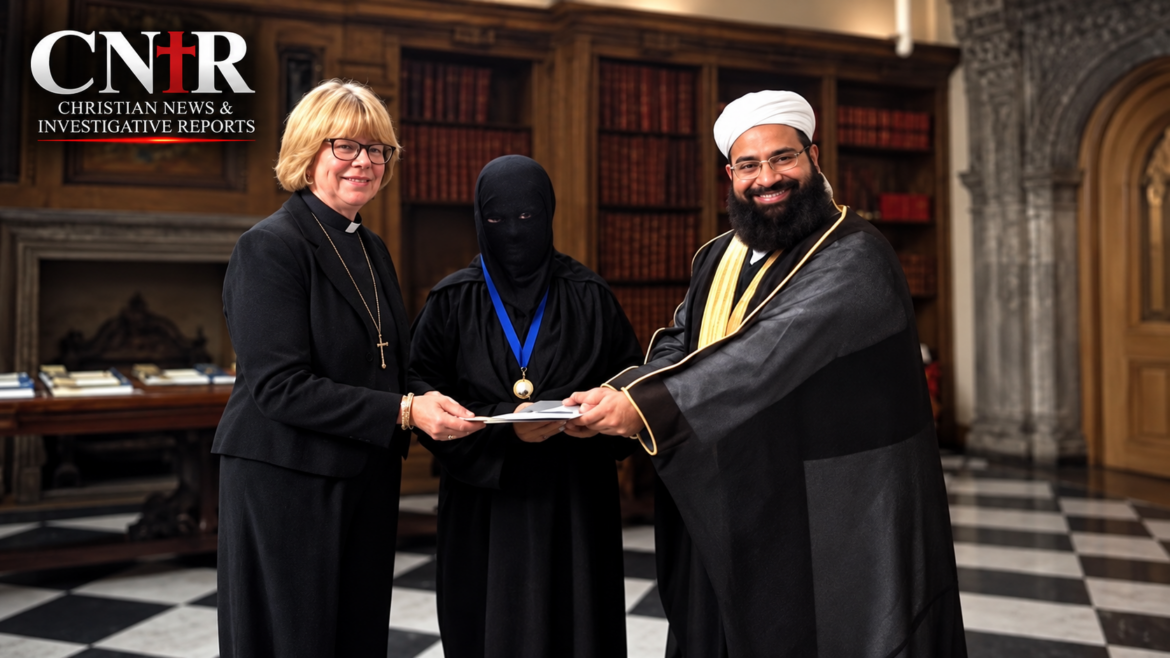
LONDON — The Church of England is facing renewed scrutiny over its spiritual direction and institutional judgment after an interfaith award presented to a Pakistani Muslim cleric on the 25th anniversary of the September 11 terrorist attacks was withdrawn following revelations about his past comments concerning Osama bin Laden.
The controversy has fueled a broader debate over whether the historic Church is maintaining a clear Christian identity at a time of declining participation and significant cultural change across Britain.
Award Presented on 25th Anniversary of 9/11
On September 11, Archbishop of Canterbury Dame Sarah Mullally presented the Hubert Walter Award for Reconciliation and Interfaith Cooperation to Hafiz Muhammad Tahir Mehmood Ashrafi during the 2026 Lambeth Awards at Lambeth Palace.
The Archbishop’s office said the annual awards recognize contributions to the Church of England, the Anglican Communion and wider society. Twenty-seven people received awards this year.
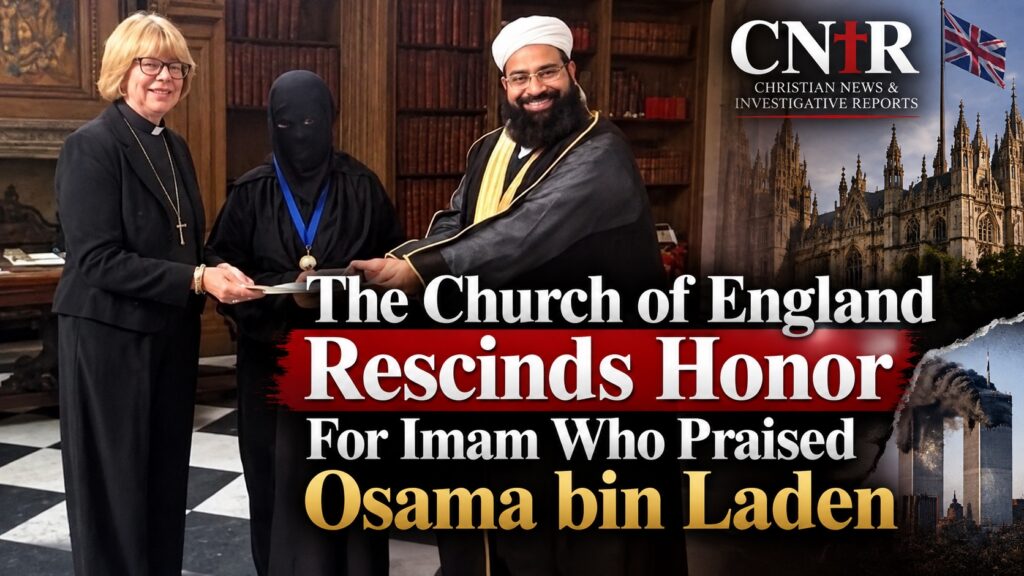
Ashrafi was recognized for work connected to interfaith relations and religious minorities in Pakistan.
But days after the ceremony, attention turned to statements Ashrafi made in 2007 following Britain’s decision to knight author Salman Rushdie.
According to multiple British news organizations, Ashrafi said at the time that he would give Osama bin Laden the Islamic honorific “Saifullah,” meaning “Sword of God,” and referred approvingly to bin Laden’s jihad against Russians, Americans and British people.
Bin Laden orchestrated the September 11, 2001 terrorist attacks that killed nearly 3,000 people.
The timing of the award therefore intensified criticism: Ashrafi received the honor exactly 25 years after those attacks.
Lambeth Palace Withdraws the Award
Following the disclosure, Lambeth Palace reversed its decision.
“Previous comments made by Imam Ashrafi have come to light that have led Lambeth Palace to reconsider this award,” the Archbishop’s office said in announcing its withdrawal.
The controversy raises an obvious question about how Ashrafi’s previous public statements were missed during the selection and vetting process.
It also raises a deeper question for the Church of England: What should Christian reconciliation look like, and where should the Church draw the line between interfaith engagement and maintaining clear moral boundaries?
A Larger Debate Over the Church’s Direction
Writing in The Spectator, columnist Ed West argued that the episode reflects something larger than an embarrassing awards controversy. He contends that the Church of England is experiencing an institutional identity crisis and is increasingly failing to provide the spiritual and moral leadership Britain needs.
That is an argument rather than an established fact, but the controversy arrives amid measurable challenges for the Church.
The debate surrounding Anglicanism increasingly concerns not simply attendance figures or church buildings, but the purpose of the institution itself.
Should the Church primarily seek accommodation with Britain’s changing culture, or should its central mission remain the proclamation of historic Christian teaching?
Those questions become particularly significant as Britain becomes increasingly religiously diverse and traditional Christian institutions compete with secularism and alternative worldviews for cultural influence.
Britain Still Searching for Spiritual Direction
More than 150 years ago, English poet Matthew Arnold used Dover Beach to describe what he saw as the retreat of religious faith from society, famously depicting the withdrawing “Sea of Faith.”
His observation resonates with the debate surrounding the Church of England today.
The controversy surrounding the Lambeth Award does not by itself establish that the Church of England is collapsing or abandoning Christianity. But it has provided critics with another reason to question the judgment, priorities and spiritual direction of Britain’s established church.
For Christians watching these developments, perhaps the most important issue extends beyond one cleric, one award or one poorly timed ceremony.
It concerns the mission of the Church itself.
At a time of cultural uncertainty, Christians may increasingly ask whether the Church of England will primarily mirror the society surrounding it—or provide a distinctly Christian voice within it.
Disclaimer: The information presented in this article is for informational and educational purposes only. Readers are advised to conduct thorough research before making any decisions. Source: Christian News & Investigative Reports (CNIR) — cnirbc.com

As a Christian this is very dangerous;
This is the new religion called “Chrislam” that Jared Kushner helped broker the Abraham Accords.
This religion is going to take over the world
As a Christian this is very dangerous;
This is the new religion called “Chrislam” that Jared Kushner helped broker the Abraham Accords.
This religion is going to take over the world
New Life Christian Church;
I don’t understand why Christians can’t see the danger of this.
The devil has just walked through the door