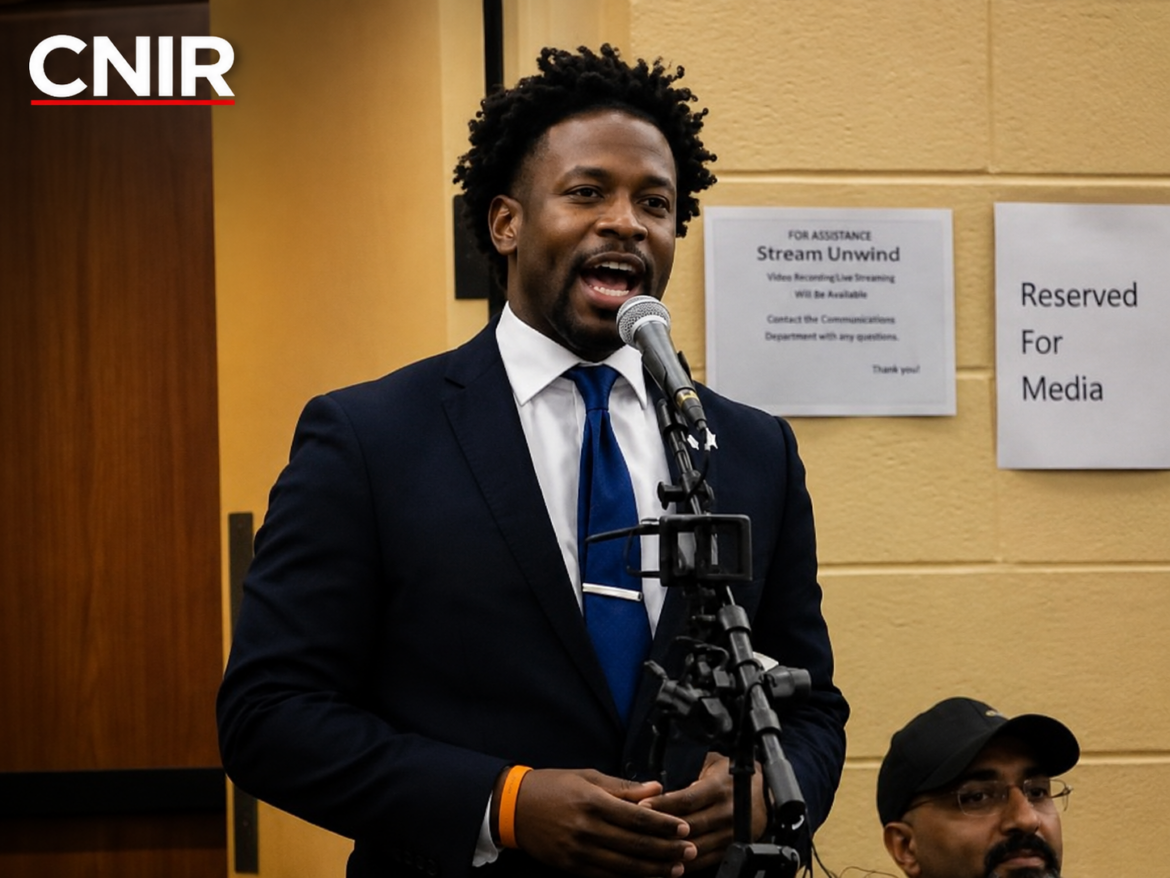
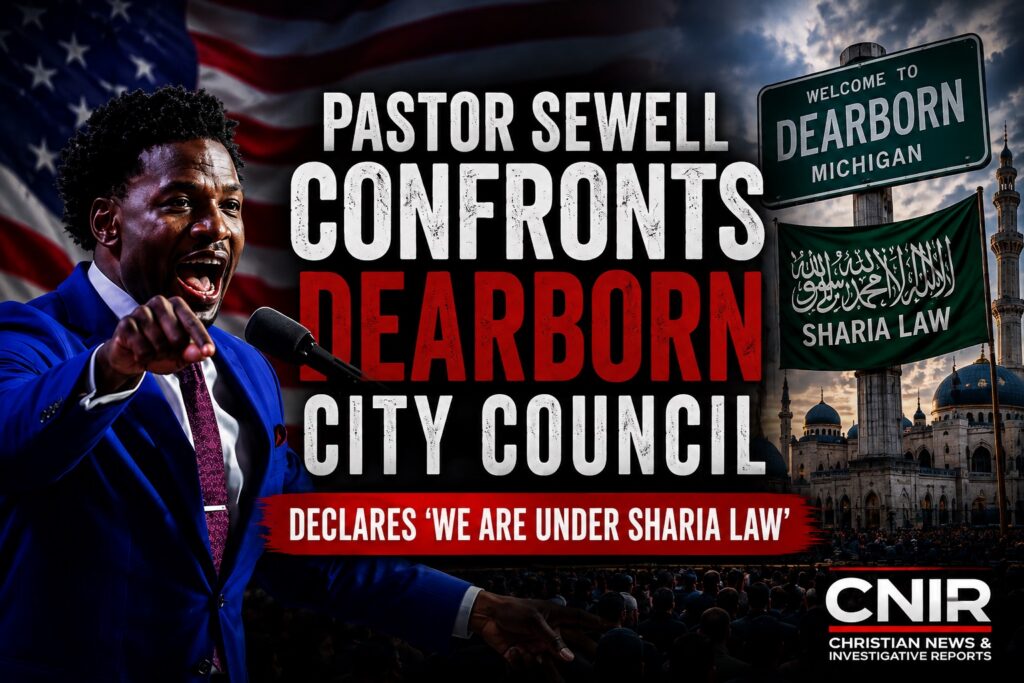
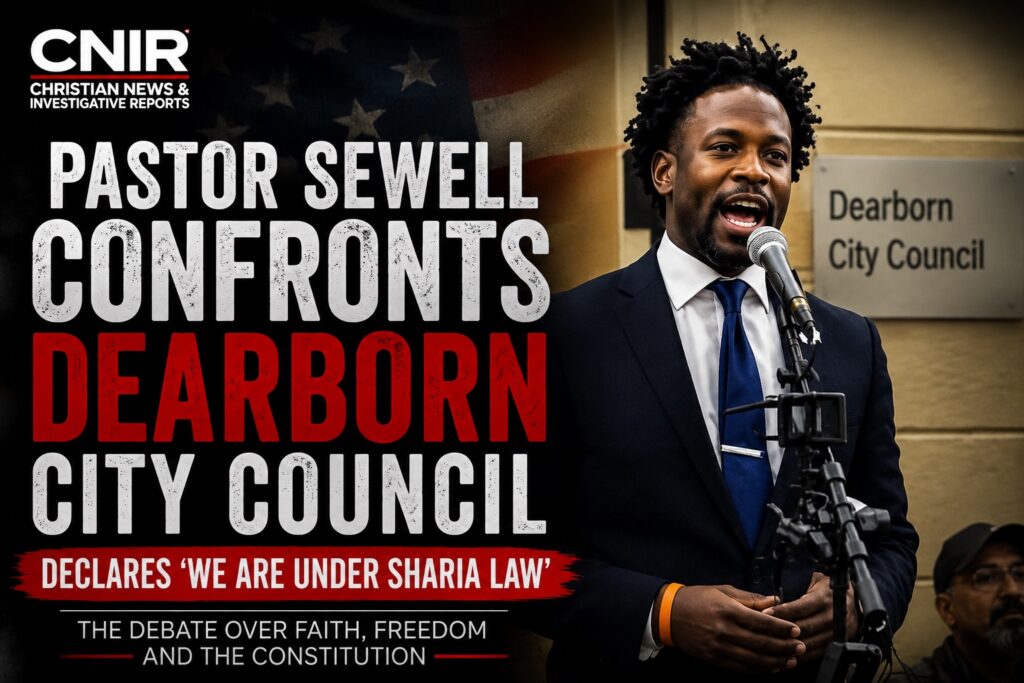
DEARBORN, Mich. — A tense Dearborn City Council meeting erupted into a national debate over Christianity, Islam, religious freedom and American law after Detroit Pastor Lorenzo Sewell confronted city leaders and declared that Dearborn was operating “under Sharia law.”
Sewell, senior pastor of 180 Church in Detroit, delivered the remarks during public comment Tuesday, August 18, as hundreds of demonstrators and counterprotesters gathered outside the Henry Ford Centennial Library.
“America, we have lost this city,” Sewell told the council. “This is a city that is no longer up under American laws; we are up under Sharia law.”
He followed with a blunt declaration: “Enough is enough.”
Pastor Challenges City Leaders
Sewell challenged members of the City Council to publicly denounce Sharia law and accused Dearborn officials of showing preferential treatment toward members of the city’s Muslim community.
His accusation immediately raised a critical factual question: Is Dearborn actually operating under Islamic religious law?
There is currently no evidence that Sharia has replaced Michigan or United States law in Dearborn. Sewell’s statement represents his interpretation of the city’s policies and treatment of religious and political disputes—not an established change in Dearborn’s legal system.
That distinction is important. But so is examining the concerns that prompted his accusation.
Sewell specifically criticized what he viewed as unequal treatment following previous confrontations involving conservative activist Jake Lang. Dearborn Police Chief Issa Shahin disputed allegations that police failed to respond appropriately to an earlier incident, saying officers responded quickly and arrests were made.
‘Christian Crusader March’ Brings Hundreds to Dearborn
The council confrontation occurred alongside a demonstration promoted as the “Christian Crusader March on Dearborn.” Sewell and Lang had been identified as organizers promoting opposition to what they described as the “Islamification of America.”
The expected turnout prompted officials to move the council meeting from its normal location to the Henry Ford Centennial Library and deploy an increased police presence.
Tensions escalated outside the building as demonstrators and counterprotesters gathered. Dearborn police later reported 22 arrests, primarily involving misdemeanor allegations including breach of peace and disorderly conduct.
Inside the meeting, Lang delivered his own highly confrontational remarks before tearing pages from what appeared to be a Quran and being escorted from the meeting.
Sewell’s message, however, centered on what he described as a conflict between American constitutional government and religious influence.
Dearborn Mayor Pushes Back
Dearborn Mayor Abdullah Hammoud rejected the broader portrayal of his city as hostile to non-Muslims or controlled by Islamic religious authority.
Hammoud emphasized Dearborn’s religious diversity and told residents they belonged in the community regardless of how they worship.
“Dearborn was built by people with different names, different accents, different traditions and different ways of worshipping God,” Hammoud said.
City officials have maintained that protesters have constitutional free-speech rights while arguing that religious disagreements should not become intimidation or hatred directed toward Muslim residents.
The Question Behind the Controversy
Dearborn is home to one of America’s largest Arab-American and Muslim communities. The city also contains a substantial Christian presence. Mayor Hammoud recently said Dearborn has nearly 30 Christian churches and slightly more than a dozen mosques.
Those demographics alone do not establish that Islamic religious law influences municipal government.
For Christians, Muslims and Americans of every faith, the constitutional question should be the same: Does government protect everyone’s religious liberty while remaining governed by American law?
That is the standard by which Sewell’s allegations ultimately must be examined.
Americans are free to practice Christianity. Americans are free to practice Islam. Americans are also free to criticize either religion. But government itself remains subject to the Constitution and the laws enacted under it.
CNIR Analysis: Asking the Difficult Question
Sewell’s confrontation should neither be dismissed simply because his language was provocative nor accepted as fact simply because it was delivered forcefully.
If a pastor claims an American municipality is effectively allowing religious doctrine to influence governmental decisions, journalists should ask for the evidence.
At the same time, having a large Muslim population, Muslim elected officials or Muslim police officers would not by itself constitute evidence of Sharia government any more than Christian officials would establish that a city was governed by biblical law.
The real investigative question is much narrower:
Can specific Dearborn laws, policies or government actions be demonstrated to favor Islamic religious principles over American constitutional law?
Pastor Lorenzo Sewell has made the accusation publicly.
Dearborn officials have rejected the characterization.
Now the facts—not fear, religious hostility or political rhetoric—must determine whether his warning withstands scrutiny.
Editorial Note
This article is intended to encourage biblical discussion—not to criticize any individual pastor, church, or denomination. CNIR affirms that Scripture honors faithful spiritual leaders while also emphasizing the importance of mentoring and preparing the next generation. Our hope is that this conversation inspires churches to remain biblically faithful, spiritually healthy, and ready for the future. This article was created with AI assistance and curated by CNIR Staff for accuracy and editorial standards. Source: Christian News & Investigative Reports (CNIR) — cnirbc.com