CNIR | Christian News & Investigative Reports
A Bible Controversy Reaches Bethel Church
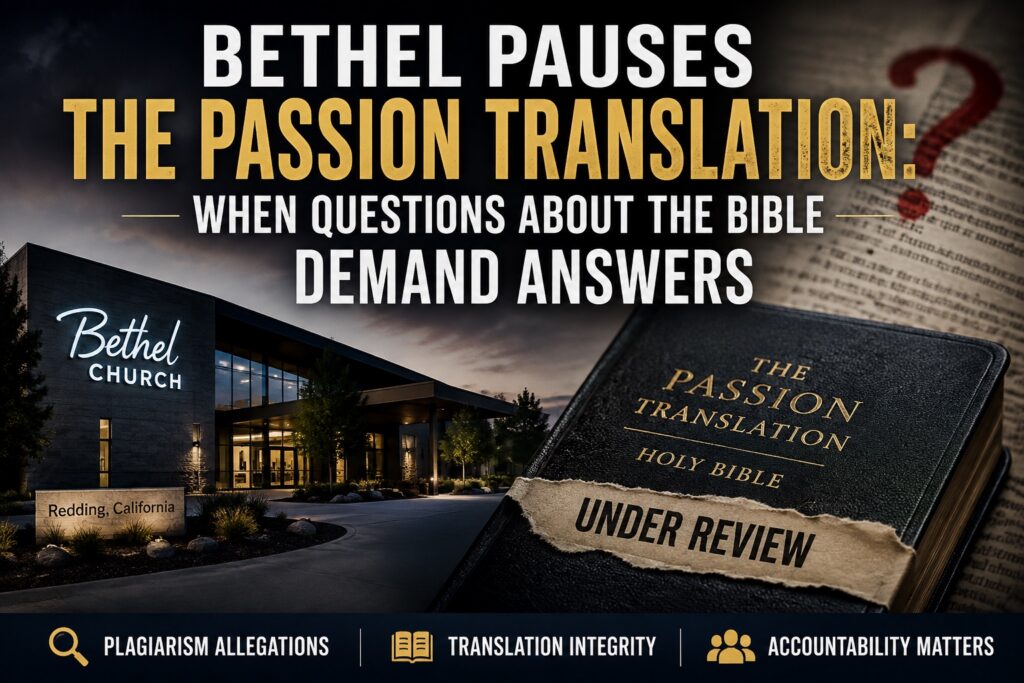
Bethel Church in Redding, California, has paused sales of The Passion Translation (TPT), a Bible version the influential charismatic church and Senior Leader Bill Johnson have strongly supported.
The decision follows renewed scrutiny surrounding allegations of plagiarism and longstanding questions about TPT’s translation methods and scholarly oversight.
Bethel confirmed that leadership has been discussing concerns surrounding TPT and said reviews are underway by qualified organizations. Until the church receives additional clarity, it has stopped selling the translation in its stores.
That distinction matters: Bethel has not announced a permanent rejection of TPT. It has paused sales pending further review.
What Are the Plagiarism Allegations?
The latest controversy centers on Brian Simmons, the principal translator of TPT.
Texas minister David Fish alleges that his research uncovered extensive instances in which wording appearing in TPT closely resembles previously published Bible versions and other sources without appropriate attribution. Fish has publicly released spreadsheets containing examples of what he considers borrowed material.
These are serious allegations, but CNIR emphasizes an important journalistic distinction: allegations are not the same as a legal finding of plagiarism. Simmons and publisher BroadStreet Publishing had not publicly provided a substantive response to the allegations in the recent reporting reviewed by CNIR.
The Bigger Question: Is TPT Really a Translation?
For Christians, the plagiarism dispute may not even be the most important issue.
Questions about TPT’s biblical accuracy existed years before the current controversy. In 2022, Bible Gateway removed TPT from its platform. At that time, Bible Gateway’s parent company said it periodically reviewed content to align with its business goals and did not publicly attribute the decision specifically to translation problems.
Nevertheless, biblical scholars have criticized TPT for including words, ideas and expansions that critics contend cannot be supported directly from the underlying Greek or Hebrew manuscripts. Some scholars therefore argue that TPT functions more like an interpretive paraphrase than a conventional Bible translation.
That distinction is significant.
A paraphrase can help readers understand Scripture devotionally, but when interpretive language is presented as translated Scripture, readers need to know where the biblical text ends and the translator’s interpretation begins.
Questions About Scholarly Review
TPT has also promoted the involvement of scholars in its review process. However, Rick Wadholm Jr., a biblical scholar who consulted on portions of the project, told The Roys Report that his role involved providing proposed revisions and feedback. He did not describe himself as having control over Simmons’ final translation decisions.
That raises an important question for churches and Bible publishers:
What level of independent scholarly review should be required before Christians are encouraged to trust a new work as a translation of Scripture?
Bethel’s Connection Makes This Significant
Bethel isn’t simply another Christian bookstore responding to controversy.
Bill Johnson has publicly endorsed TPT and regularly quoted it in sermons. Bethel also sold a special edition containing a 16-page foreword from Johnson. That history makes the church’s decision to pause sales noteworthy.
At the same time, Bethel’s present decision should be reported fairly. Pausing sales while serious allegations are examined can be viewed as an act of caution rather than an admission that every accusation against TPT is true.
CNIR Analysis: The Bible Deserves the Highest Standard
The larger issue extends beyond Bethel Church, Brian Simmons or The Passion Translation.
Millions of Christians open a Bible believing they are reading a trustworthy rendering of ancient Scripture. Publishers, translators, pastors and ministries therefore carry an enormous responsibility when placing the words “Bible translation” on a book.
Christians should not be afraid of scholarly examination of a Bible translation. Scripture itself encourages careful study.
2 Timothy 2:15 (KJV):
“Study to shew thyself approved unto God, a workman that needeth not to be ashamed, rightly dividing the word of truth.”
The ultimate question isn’t whether someone likes or dislikes The Passion Translation.
The question is whether Christians can confidently distinguish the original message of Scripture from the interpretation of the person translating it.
For something Christians call the Word of God, that distinction matters.
Editorial Note
This article is intended to encourage biblical discussion—not to criticize any individual pastor, church, or denomination. CNIR affirms that Scripture honors faithful spiritual leaders while also emphasizing the importance of mentoring and preparing the next generation. Our hope is that this conversation inspires churches to remain biblically faithful, spiritually healthy, and ready for the future. This article was created with AI assistance and curated by CNIR Staff for accuracy and editorial standards. Source: Christian News & Investigative Reports (CNIR) — cnirbc.com