JERUSALEM — As Israel prepares to enter Tishrei 5787, one of the most significant months on the biblical calendar, developments taking place on Jerusalem’s Temple Mount are drawing renewed attention from Jews, Christians and Bible prophecy observers around the world.
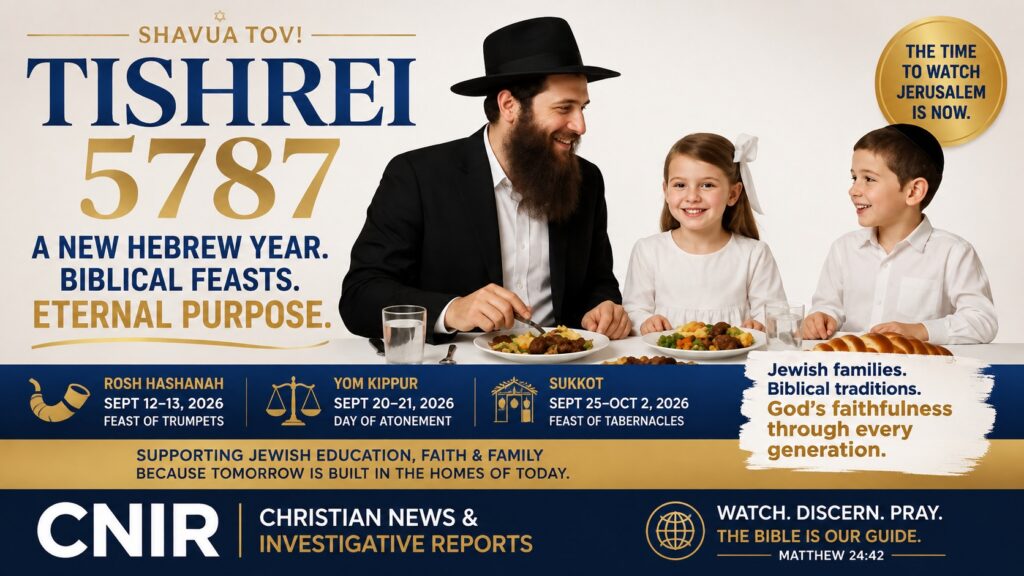
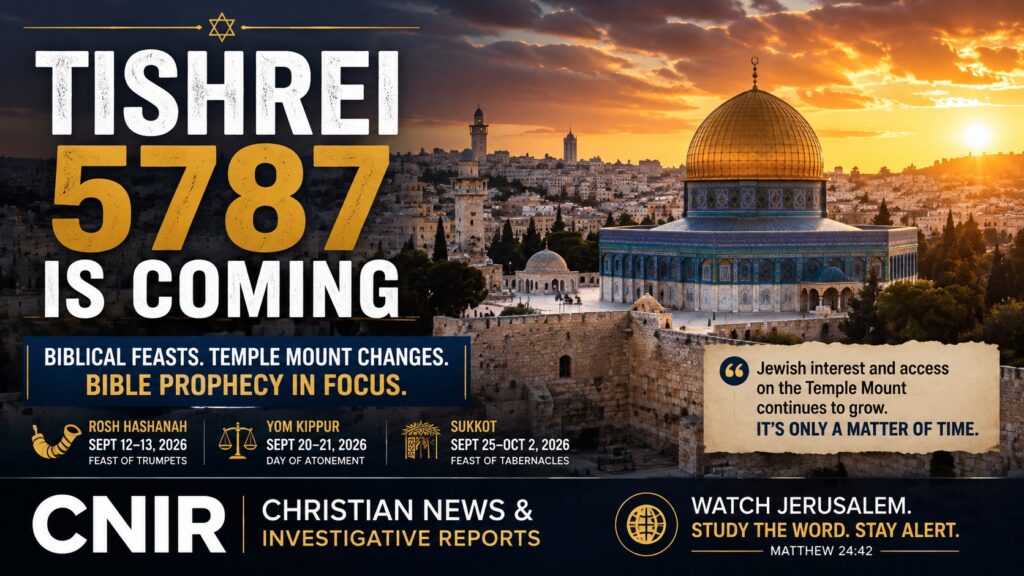
Tishrei begins at sundown September 11, 2026, ushering in a remarkable succession of biblical observances: the Feast of Trumpets, the Day of Atonement and the Feast of Tabernacles.
At the same time, reports indicate that Jewish religious activity on the Temple Mount continues to expand—raising a larger question for Christians watching Jerusalem:
Are we witnessing ordinary historical and political developments, or are pieces gradually moving into positions that could become significant to future biblical prophecy?
Tishrei 5787: A Month Filled With Biblical Significance
Tishrei is the seventh month of the biblical religious calendar and the beginning of the traditional Jewish civil year.
Three major biblical observances occur during the month.
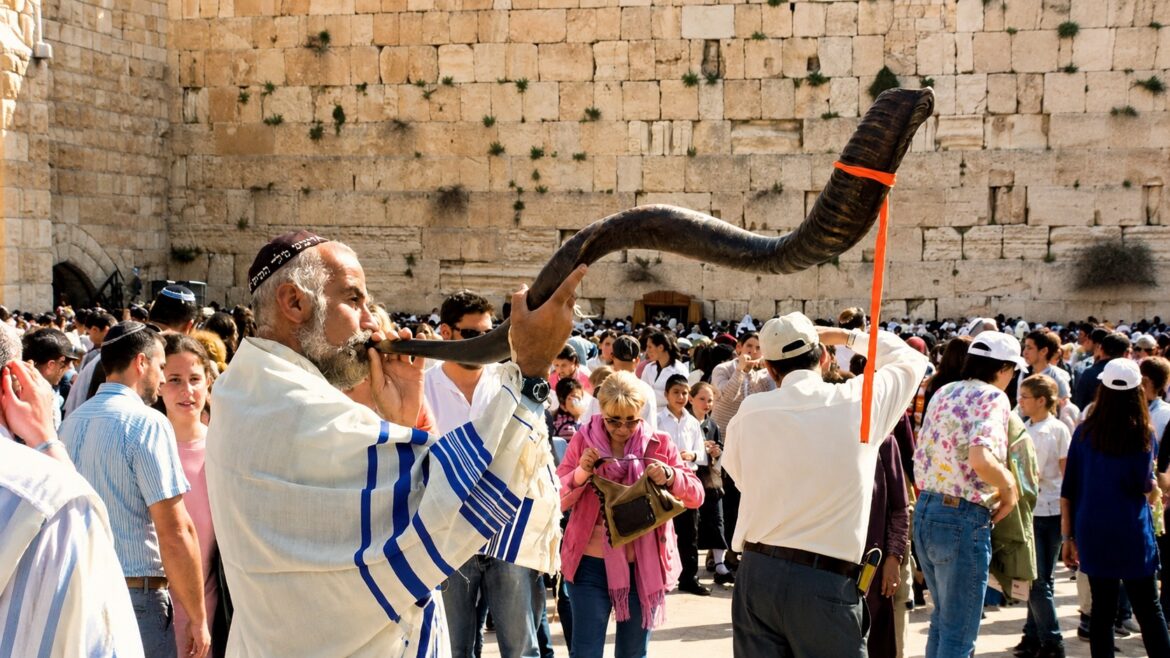
September 11–13 — Rosh Hashanah / Feast of Trumpets
Tishrei begins at sundown September 11, with 1 Tishrei falling September 12. Rosh Hashanah continues through September 13.
The biblical foundation appears in Leviticus 23:24–25, where Israel was commanded to observe a memorial accompanied by the blowing of trumpets and a holy convocation.
“In the seventh month, in the first day of the month, shall ye have a sabbath, a memorial of blowing of trumpets…” — Leviticus 23:24 KJV
Today the observance is commonly known as Rosh Hashanah, the Jewish New Year.
September 20–21 — Yom Kippur
Beginning at sundown September 20, Israel observes Yom Kippur, the Day of Atonement, on 10 Tishrei.
Leviticus 23:27 declares:
“Also on the tenth day of this seventh month there shall be a day of atonement…” — Leviticus 23:27 KJV
Yom Kippur remains Judaism’s most solemn holy day—a period traditionally characterized by fasting, repentance and prayer.
September 25–October 2 — Sukkot
Beginning at sundown September 25, the Jewish people enter Sukkot, or the Feast of Tabernacles.
Leviticus 23:34 identifies the feast as beginning on the fifteenth day of the seventh month and continuing seven days.
Sukkot is particularly interesting to Christian prophecy students because the prophet Zechariah describes nations going to Jerusalem to worship the King and celebrate the Feast of Tabernacles in a future prophetic setting.
Zechariah 14:16 says:
“And it shall come to pass, that every one that is left of all the nations which came against Jerusalem shall even go up from year to year to worship the King… and to keep the feast of tabernacles.”
Something Is Changing on the Temple Mount
The approaching biblical feast season comes amid significant developments surrounding the Temple Mount, Judaism’s holiest site and the location where the First and Second Temples once stood.
A recent Temple Mount advocacy statement claimed that 9,370 Jews ascended and prayed on the Temple Mount during the Hebrew month of Av, and that 64,932 Jewish visitors had ascended since the beginning of the Hebrew year.
CNIR has not independently verified those exact figures and therefore presents them as figures reported by the organization rather than independently established statistics.
Nevertheless, other developments provide evidence of a broader shift.
In August, The Times of Israel reported that Jewish worshipers were apparently permitted to bring siddurim—Jewish prayer books—onto the Temple Mount, something reportedly prohibited in previous years.
Historically, the site’s sensitive “status quo” has permitted non-Muslims to visit during designated periods while restricting non-Muslim prayer. Enforcement, however, has changed considerably in recent years, with Jewish prayer increasingly occurring at the site.
These developments remain deeply controversial. Muslims know the compound as Haram al-Sharif, home to the Al-Aqsa Mosque and Dome of the Rock, making changes involving Jewish worship politically and religiously explosive.
Why Christians Are Watching
For Bible-believing Christians, the importance of Jerusalem extends beyond contemporary Israeli politics.
Several New Testament prophetic passages describe circumstances involving a sanctuary or holy place in events associated with the end times.
Jesus said:
“When ye therefore shall see the abomination of desolation, spoken of by Daniel the prophet, stand in the holy place…” — Matthew 24:15 KJV
Paul similarly describes a future figure associated with rebellion against God:
“…so that he as God sitteth in the temple of God, shewing himself that he is God.” — 2 Thessalonians 2:4 KJV
Daniel 9:27 also describes the stopping of “the sacrifice and the oblation,” a passage that has played an important role in many Christian interpretations of end-times prophecy.
For Christians who interpret these passages as referring to a future literal Temple in Jerusalem, renewed Jewish interest in the Temple Mount naturally attracts attention.
But an important distinction must be maintained.
The Bible does not say that increasing Jewish visits to the Temple Mount prove that a Third Temple is about to be constructed.
Nor does Scripture give Christians a timetable based upon Temple Mount visitor statistics.
What these developments demonstrate is something more limited—but nevertheless historically significant: Jewish religious activity concerning the Temple Mount is an increasingly visible part of Israeli public life.
Prophecy or Preparation?
That distinction matters.
Bible prophecy should not be interpreted by forcing every headline into Scripture. Christians have repeatedly made that mistake throughout history.
Instead, current developments should be compared carefully with the biblical text.
The Temple Mount is important because Scripture repeatedly places Jerusalem at the center of significant future events.
Zechariah 12:3 describes Jerusalem becoming “a burdensome stone for all people.”
Jesus spoke prophetically concerning Jerusalem in Luke 21.
Revelation 11 describes a temple, an altar and Jerusalem in an explicitly prophetic context.
None of those passages establishes that the events of August or September 2026 fulfill those prophecies.
But they explain why Jerusalem—and particularly the Temple Mount—continues to command the attention of Christians who study biblical prophecy.
Tishrei Is About More Than Prophecy
There is also a danger in allowing prophecy discussions to overshadow the spiritual meaning of the biblical feasts themselves.
Trumpets calls attention.
Atonement confronts humanity with sin and reconciliation.
Tabernacles points toward God’s presence among His people.
For Christians, those themes ultimately point toward Jesus Christ.
The New Testament presents Christ as the fulfillment of God’s redemptive plan, declaring in Hebrews 9:12 that Christ entered “once into the holy place” and obtained “eternal redemption for us.”
Therefore, Christians watching events surrounding Jerusalem should not become consumed with attempting to predict dates.
Jesus Himself warned:
“Watch therefore: for ye know not what hour your Lord doth come.” — Matthew 24:42 KJV
CNIR Perspective: Watch Jerusalem—But Watch Carefully
Tishrei 5787 arrives at an extraordinary moment.
Jewish religious interest in the Temple Mount is visible. Prayer practices appear to be changing. Debate concerning Jewish rights at the site continues. Meanwhile, the biblical feasts once again turn international attention toward Jerusalem.
These developments deserve serious observation.
But observation is not the same as declaring fulfillment.
CNIR believes Christians can watch biblical developments without sensationalism. The responsible question is not, “Can we make today’s headline fit prophecy?”
The better question is:
“What does Scripture actually say, and how closely do today’s developments correspond with it?”
As Tishrei 5787 begins, Jerusalem will once again become the focal point of ancient biblical observances practiced thousands of years after they were first commanded.
And from a Christian perspective, that alone makes this coming month worth watching.
Editorial Note
This article is intended to encourage biblical discussion—not to criticize any individual pastor, church, or denomination. CNIR affirms that Scripture honors faithful spiritual leaders while also emphasizing the importance of mentoring and preparing the next generation. Our hope is that this conversation inspires churches to remain biblically faithful, spiritually healthy, and ready for the future. This article was created with AI assistance and curated by CNIR Staff for accuracy and editorial standards. Source: Christian News & Investigative Reports (CNIR) — cnirbc.com