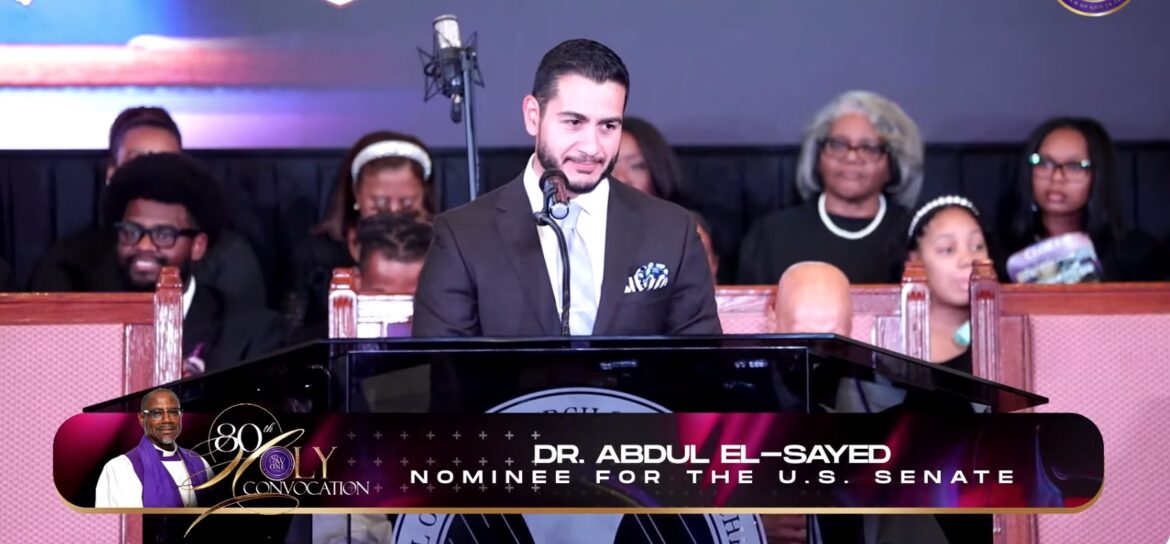
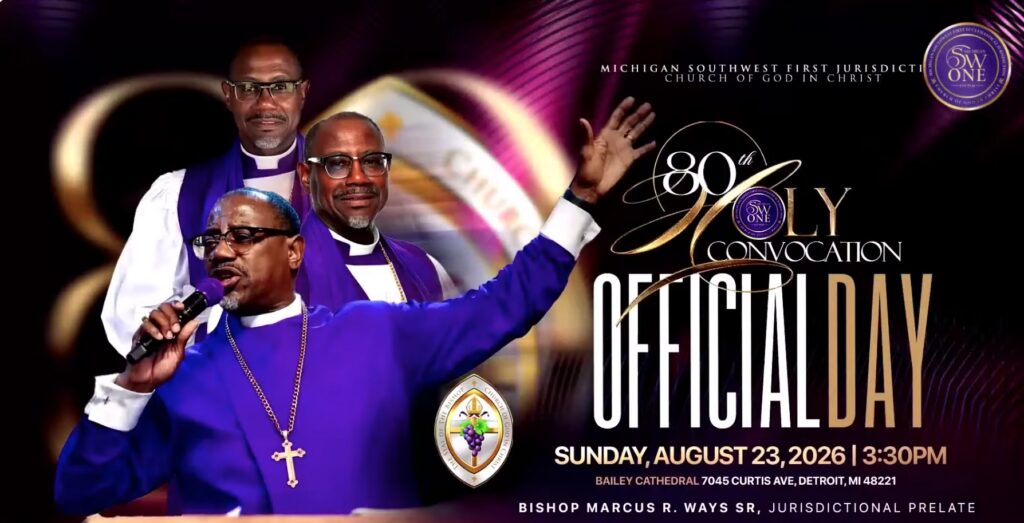
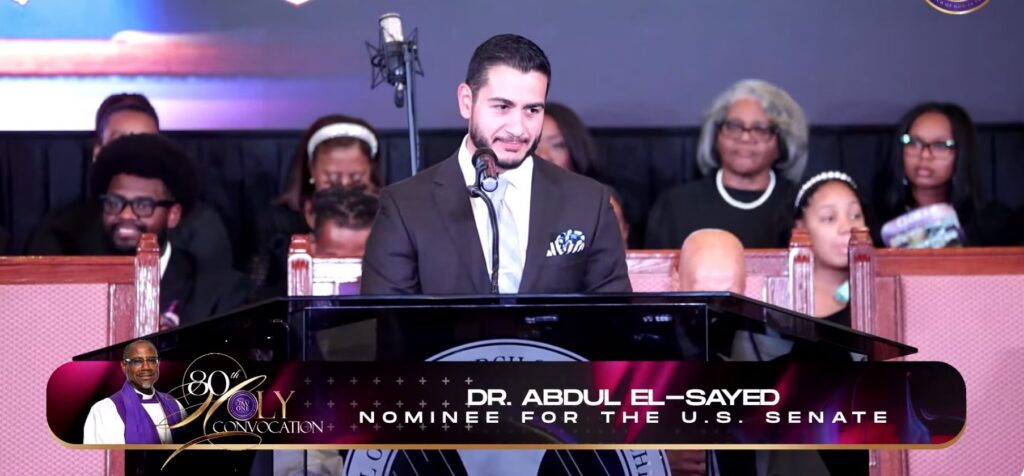
MICHIGAN — Democratic U.S. Senate nominee Abdul El-Sayed, a practicing Muslim whose faith has become a national campaign issue, appeared before a Christian audience during the Michigan Southwest First Church of God in Christ’s 80th Holy Convocation, adding another dimension to Michigan’s increasingly visible conversation about Christianity, Islam and political influence.
During the Official Day Service, El-Sayed is introduced as a political and community guest at approximately the 42:06 mark before being given an opportunity to address the congregation.
The appearance itself does not establish that COGIC endorsed El-Sayed politically or embraced his Islamic beliefs. However, it raises a significant question for Christians: Where is the appropriate boundary between civic engagement with political leaders of other faiths and maintaining an unmistakably Christian witness?
Michigan’s Religious Debate Moves Into Politics
El-Sayed won Michigan’s Democratic Senate nomination and faces Republican Mike Rogers in November. If elected, he would become the first Muslim to serve in the U.S. Senate.
His Muslim faith has increasingly become part of the national political debate. Republican leaders have sharply criticized El-Sayed, while some accusations circulating online have gone substantially further than available evidence supports. Claims that El-Sayed called for imposing Sharia law on the United States, for example, have been fact-checked and found to misrepresent his previous statements.
Dearborn Becomes a National Flashpoint
The COGIC appearance also comes amid heightened religious tensions surrounding Dearborn, home to large Muslim and Christian communities.
In August, conservative activist Jake Lang and Detroit pastor Lorenzo Sewell organized what was promoted as a “Christian Crusader March,” opposing what organizers described as the “Islamification of America.” The demonstration attracted counterprotesters, a significant police response and multiple arrests.
Yet Christian leaders in the Dearborn area have not spoken with one voice about the confrontational approach. Some joined Muslim leaders in publicly calling for peace and religious coexistence.
Christianity and Islam Remain Theologically Different
For Christians, peaceful coexistence does not require theological agreement.
COGIC’s official statement of faith declares belief in one God revealed as Father, Son and Holy Spirit and teaches that cleansing from sin comes through repentance and faith in Jesus Christ. Islam does not share those central Christian doctrines.
That distinction makes El-Sayed’s appearance noteworthy without making it inherently improper.
The larger question confronting Michigan churches may therefore be more complicated than whether Christians should interact with Muslim political leaders. It is whether the Church can participate in America’s increasingly diverse political environment while clearly communicating what Christianity teaches about Jesus Christ.
For Christian voters, political hospitality, political endorsement and theological fellowship are not necessarily the same thing.
Disclaimer: The information presented in this article is for informational and educational purposes only. Readers are advised to conduct thorough research before making any investment decisions. Source: Christian News & Investigative Reports (CNIR) — cnirbc.com