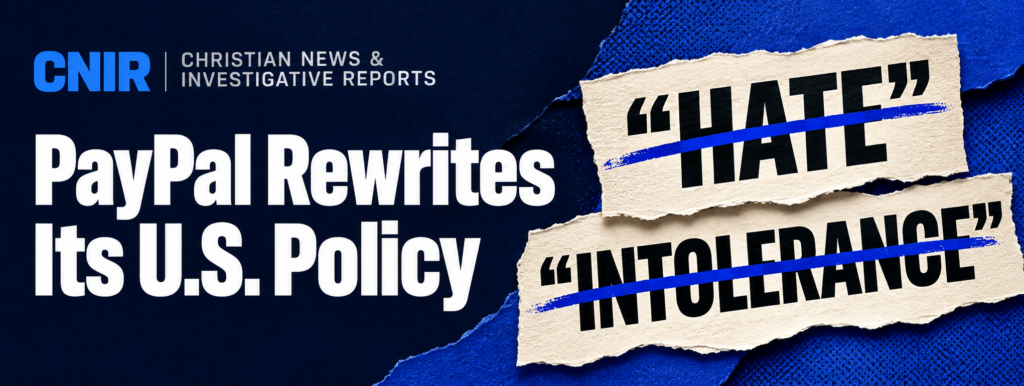
PayPal revised its U.S. Acceptable Use Policy on November 4, 2026, after a Christian legal advocacy group warned federal regulators that broad language in the company’s rules could put customers at risk of losing access to payment services over their religious or political views.
The update removes the terms “hate” and “intolerance” from a provision on prohibited transactions. PayPal also says in its U.S. Help Center that it bases account decisions on customer activity and excludes religion and political affiliation from those decisions.
What Changed in PayPal’s U.S. Policy
The previous policy used broad language about hate and intolerance alongside its prohibition on transactions involving violence. The revised provision still restricts transactions involving violence and specifies the characteristics covered by its rule on discriminatory activity, including religion, race, disability, gender, sexual orientation and national origin.
PayPal also outlined a separate change to its rule on misleading information in a September 15 letter to the Federal Deposit Insurance Corporation, according to The Christian Post. The company told the regulator it would narrow that rule to cover communications about PayPal transactions.
Why a Christian Legal Group Objected
Alliance Defending Freedom raised its concerns with the FDIC in July while PayPal was seeking deposit insurance for a proposed industrial bank in Utah. The advocacy group argued that the wording of PayPal’s policies gave the company too much discretion to restrict accounts over lawful speech or beliefs.
The group cited two examples from 2022. It said PayPal froze accounts belonging to the Free Speech Union and its founder, as well as accounts belonging to Moms for Liberty. According to the group, PayPal reversed the Moms for Liberty restrictions following public criticism. The examples concern the group’s allegations about political expression. Its announcement identifies no case in which PayPal restricted an account solely because a customer held Christian beliefs.
Alliance Defending Freedom withdrew its objection after PayPal informed the FDIC of the changes. The group said it understood the revised language to apply to unlawful discrimination while preserving lawful religious practice and speech.
How the PayPal Dispute Fits the Debanking Debate
The objection cited Executive Order 14331, which President Donald Trump signed in August 2025. The order directs federal banking regulators to review supervisory records and complaints for evidence of unlawful debanking based on religion. It also directs regulators to remove reputational risk from their guidance and examination materials.
For churches and ministries that use PayPal for online giving, the company’s published policy lists collecting donations as a charity or nonprofit among the activities requiring advance approval. PayPal’s Help Center identifies suspected fraud, unauthorized access and other account activity as reasons it may limit an account. Alliance Defending Freedom said it would monitor how PayPal applies the revised rules.
CNIR Verification Sources
- PayPal, U.S. Acceptable Use Policy and Help Center guidance on account limitations
- Alliance Defending Freedom, November 5, 2026, statement on PayPal’s policy revision
- The Christian Post, November 7, 2026, reporting on PayPal’s letter to the FDIC
- Federal Register, Executive Order 14331, Guaranteeing Fair Banking for All Americans
Disclaimer
This report is provided for informational and educational purposes.
Source — CNIR | cnirbc.com