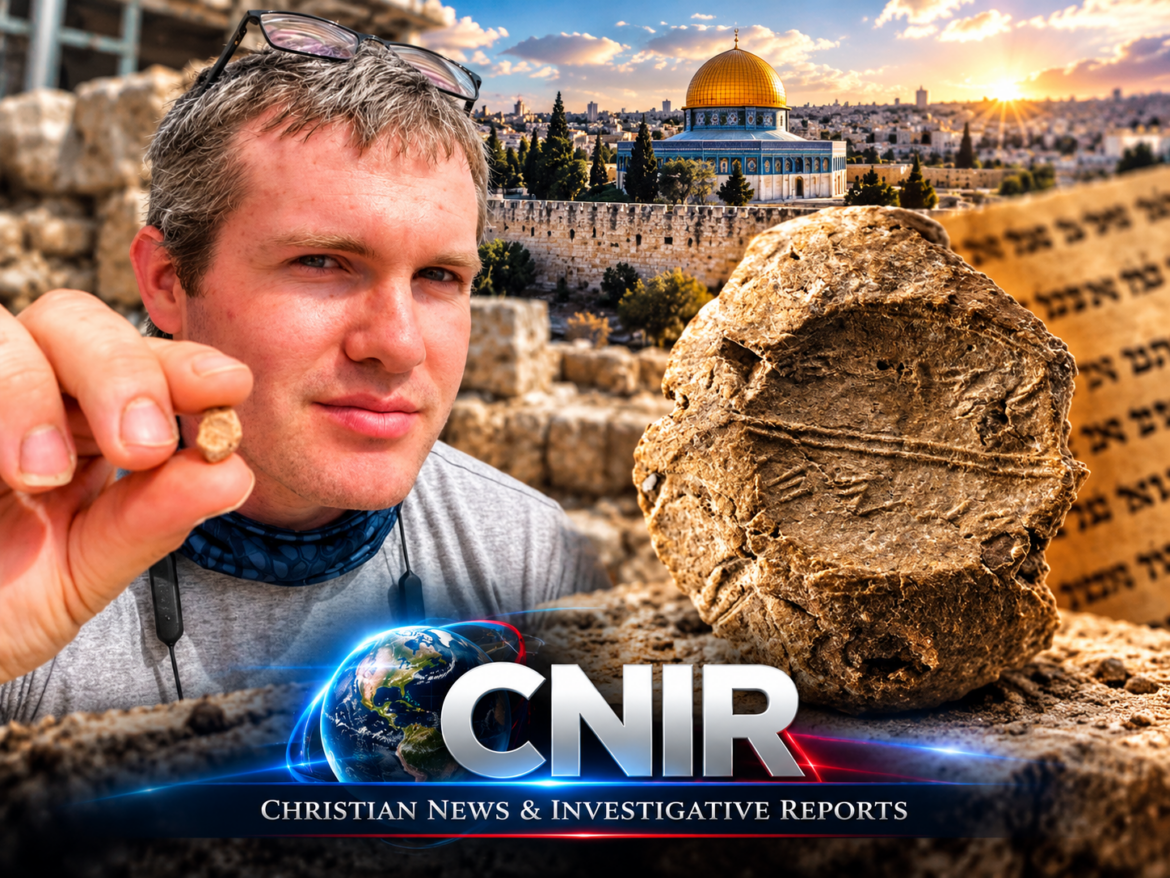
An ancient Hebrew inscription recovered from Temple Mount soil has prompted researchers to investigate a possible connection to a royal official named in the Old Testament.
THE EVIDENCE ROOM | INVESTIGATION #006
Archaeological Discovery Sparks Biblical Investigation
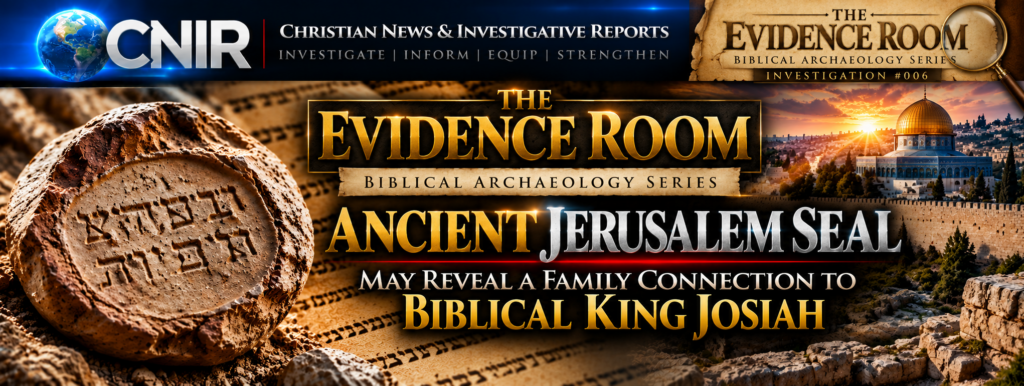
JERUSALEM — An ancient clay seal impression recovered from soil associated with Jerusalem’s Temple Mount is attracting attention for its possible connection to a royal official who served during the reign of King Josiah of Judah.
The artifact bears a Hebrew inscription identifying an individual named Yeda‘yah, son of Asayahu. Researchers believe the father’s name may correspond to Asaiah, a figure mentioned in the biblical accounts of Josiah’s administration.
The discovery was reported in 2025, with additional attention emerging in 2026 as researchers prepared a scholarly examination of the inscription.
Although the potential biblical connection has generated interest, archaeologists have not established that the individual named on the seal belonged to the family of the official described in Scripture.
Ancient Hebrew Inscription Provides Historical Clues
The object is a bulla, a small piece of clay impressed with an engraved seal. Such impressions were commonly used in antiquity to secure documents and identify individuals involved in administrative transactions.
The inscription identifies Yeda‘yah as the son of Asayahu, providing researchers with two personal names that can be compared with historical and biblical records.
The seal impression is associated with the First Temple period, an era encompassing the final centuries of the Kingdom of Judah before Jerusalem’s destruction by the Babylonians in 586 BC.
Its importance rests on the possibility that the names may correspond to individuals associated with Judah’s royal administration.
However, identifying similar names in separate ancient sources does not necessarily establish that they refer to the same people.
Biblical Account Identifies Asaiah as a Royal Official
The proposed connection centers on Asaiah, whose name appears in 2 Kings 22:12 and 2 Chronicles 34:20.
According to the biblical narrative, Asaiah served King Josiah during a period of religious reform in Judah.
The account describes the discovery of the Book of the Law during repairs to the Temple. After hearing its contents, Josiah instructed several officials to seek guidance concerning the nation’s relationship with God.
The King James Version records:
“And the king commanded Hilkiah the priest, and Ahikam the son of Shaphan, and Achbor the son of Michaiah, and Shaphan the scribe, and Asahiah a servant of the king, saying,” — 2 Kings 22:12 (KJV)
The name appears as Asahiah in this English translation, while other transliterations use Asaiah.
If researchers eventually demonstrate that the Asayahu named on the clay impression was the biblical official, the artifact could provide evidence of a family associated with Josiah’s court.
The inscription itself, however, does not mention Josiah or identify Asayahu as a royal servant.
Temple Mount Research Provides Important Context
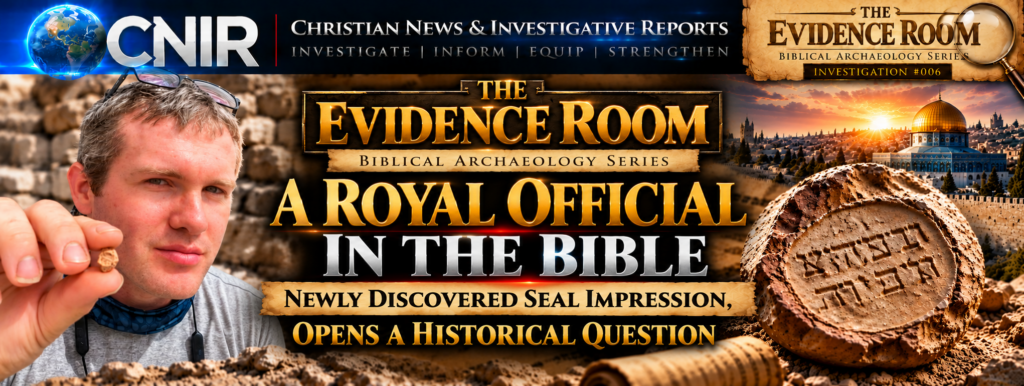
The Temple Mount Sifting Project has spent more than two decades examining archaeological material removed from the Temple Mount area.
Established in 2004, the initiative has recovered artifacts representing numerous periods of Jerusalem’s history, including pottery, coins, architectural fragments, and ancient seal impressions.
Researchers examine these materials to gain additional insight into the city’s political, religious, and administrative development.
Because much of the soil was displaced before archaeological examination, the original location of individual discoveries cannot always be determined.
This limitation is particularly important when attempting to connect an artifact to a specific historical person or event.
Nevertheless, inscriptions can preserve names and administrative details that contribute to the study of ancient Judah.
Does the Seal Confirm a Biblical Figure?
The discovery raises a question frequently examined in Christian apologetics: Can archaeology independently substantiate individuals and events recorded in the Bible?
Ancient inscriptions have contributed significantly to historians’ understanding of the kingdoms of Israel and Judah.
However, archaeological evidence must be interpreted according to its historical context rather than presumed to confirm a biblical account.
In this case, the proposed connection depends on the inscription’s reading, its dating, the rarity of the names, and the available historical evidence.
Even a confirmed identification would establish a limited historical connection, not independently verify every event described in the biblical narrative.
Researchers must therefore distinguish between a plausible identification and a demonstrated historical conclusion.
CNIR Conclusion: A Small Artifact With Historical Significance
The Yeda‘yah seal impression represents an intriguing addition to the archaeological record of ancient Jerusalem.
Its possible relationship to a royal official named in Scripture makes it particularly relevant to investigations concerning the historical background of the Old Testament.
Yet the evidence remains preliminary regarding the proposed identification.
Further scholarly examination will be necessary to determine whether the names represent an actual connection to King Josiah’s administration or merely resemble those preserved in the biblical record.
For now, the discovery offers a historically significant question rather than a definitive answer: Could an ancient clay impression preserve evidence of a family connected to one of Judah’s most influential kings?
Article Source Verification
The following sources were checked to verify the discovery, inscription, historical dating, and status of the proposed biblical identification.
Temple Mount Sifting Project — July 30, 2025. Original announcement identifying the artifact, its inscription, discoverer Mordechai Ehrlich, and preliminary interpretation by researchers Anat Mendel-Geberovich and Zachi Dvira.
Temple Mount Sifting Project — June 11, 2026. Report on the presentation of initial findings at Israel’s 50th Archaeological Congress, including the possible connection to Josiah’s official.
Jewish News Syndicate — October 15, 2026. Updated reporting confirming that a peer-reviewed study was being prepared for the Israel Exploration Journal, with publication anticipated before the end of 2026
The Times of Israel — July 30, 2025. Independent coverage of the artifact’s discovery, inscription, and archaeological context.
CNIR verification finding:
The clay seal impression is a documented archaeological discovery. Its proposed association with the family of King Josiah’s official remains a scholarly hypothesis, not an established identification. No evidence reviewed justifies reporting that the artifact definitively proves the biblical account.
CNIR Editorial Disclaimer
This investigation is presented for educational, historical, and Christian apologetics purposes. CNIR seeks to distinguish documented evidence, scholarly interpretation, and theological conclusions. Readers are encouraged to examine primary sources and evaluate the evidence independently.