CNIR | Christian News & Investigative Reports
A growing theological debate is confronting the Black Christian church, and a recent conversation between Pastor Frederick K. C. Price Jr. and representatives of Israel United in Christ (IUIC) demonstrates just how significant the disagreements have become.
The discussion was not simply about race or whether Black Americans have connections to biblical Israel. Price began with something much more fundamental: Who is Jesus Christ? Was He born of a virgin? Is He God?
The answers revealed substantial differences between IUIC theology and historic Christian teaching.
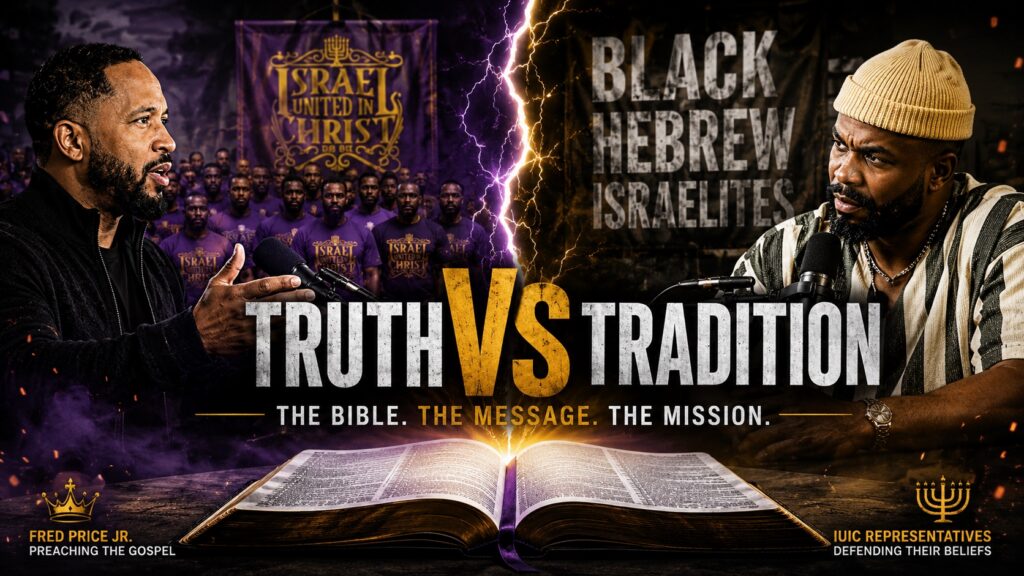
Who Is Jesus?
During the discussion, IUIC representatives described Jesus as Savior, Creator and “our God,” while distinguishing Him from God the Father. They also argued that Christ Himself was created by the Father.
That immediately raises an important biblical question.
Fred Price Jr.’s side: Jesus is the eternal, divine Son of God who existed before His incarnation, was born of a virgin, and is fully divine.
IUIC’s side: Jesus is the Son of God and Messiah but not God the Father, was brought forth/created by God, and they rejected the traditional doctrine of the virgin birth.
In His earthly life, Jesus prayed in John 17:5 about the glory He possessed with the Father “before the world was.”
The Black Hebrew Israelites must understand the distinction between the divine nature of Christ—His heavenly, pre-incarnate existence—and His human nature revealed through His earthly incarnation. Jesus did not begin to exist at Bethlehem. John 17:5 declares that He shared glory with the Father “before the world was.” His birth in Bethlehem marks His entrance into human history as Jesus of Nazareth, not the beginning of His existence.
A Major Disagreement Over the Virgin Birth
IUIC also challenged Christianity’s traditional understanding of Christ’s virgin birth. Price’s side responded from Matthew 1, emphasizing that Mary was found pregnant before she and Joseph came together and that Scripture identifies her conception as being “of the Holy Ghost.”
Again, the issue goes directly to the identity of Jesus.
The Virgin Birth
Black Hebrew Israelites must consider the creative power of God. If God created Adam from the dust and “breathed into his nostrils the breath of life” (Genesis 2:7), then surely God possessed the power to cause life to begin within Mary’s womb without a human father. The God who created human life in the beginning was fully capable of bringing forth the humanity of Jesus through the virgin Mary by the power of the Holy Ghost.
Did Jesus Come Only for Israel?
Perhaps the sharpest disagreement came later.
An IUIC representative explicitly argued that Christ “did not come for all nations” and “only came for the nation of Israel.”
That claim raises serious questions when compared with passages such as John 3:16, Matthew 28:19, Romans 10:12–13 and Revelation 7:9, where the Gospel and redemption extend across national and ethnic boundaries.
More Than a Debate About Race
This is what makes the Hebrew Israelite discussion important.
The central question is not what clothing members wear, how they march, or even what ethnicity they claim.
The deeper issue is biblical interpretation.
IUIC representatives quote Scripture extensively and present an interconnected theology concerning Christ, Israel, salvation, the Law and ethnic identity. However, the Black Hebrew Israelites must understand the fundamentals of academically studying Scripture and recognize the importance of proper biblical exegesis. Sound exegesis seeks to draw meaning out of the text rather than impose meaning upon it. Every passage must be examined according to its content, historical setting, language, immediate context, and the broader witness of Scripture.
More importantly, for students of the Word of God, they do not study Scripture simply to prove themselves right or someone else wrong. They study to discover what God has actually said. Paul instructed Timothy to, “Study to shew thyself approved unto God, a workman that needeth not to be ashamed, rightly dividing the word of truth” (2 Timothy 2:15, KJV).
When interpreting biblical Scripture, context is essential. A verse removed from its context can easily be made to support an idea the biblical author never intended. The objective is not winning the argument—it is rightly dividing the Word of truth.
CNIR will continue examining these claims individually, beginning with Christianity’s most important question:
Who is the Holy Ghost?
Editorial Note
This article is intended to encourage biblical discussion—not to criticize any individual pastor, church, or denomination. CNIR affirms that Scripture honors faithful spiritual leaders while also emphasizing the importance of mentoring and preparing the next generation. Our hope is that this conversation inspires churches to remain biblically faithful, spiritually healthy, and ready for the future. This article was created with AI assistance and curated by CNIR Staff for accuracy and editorial standards. Source: Christian News & Investigative Reports (CNIR) — cnirbc.com