Christian News & Investigative Reports | cnirbc.com
The office of the President of the United States carries extraordinary influence. Every endorsement, business connection, and financial disclosure draws national attention. That is why President Trump’s reported royalty income connected to the God Bless the USA Bible has sparked a conversation reaching far beyond politics and into the sanctuary.
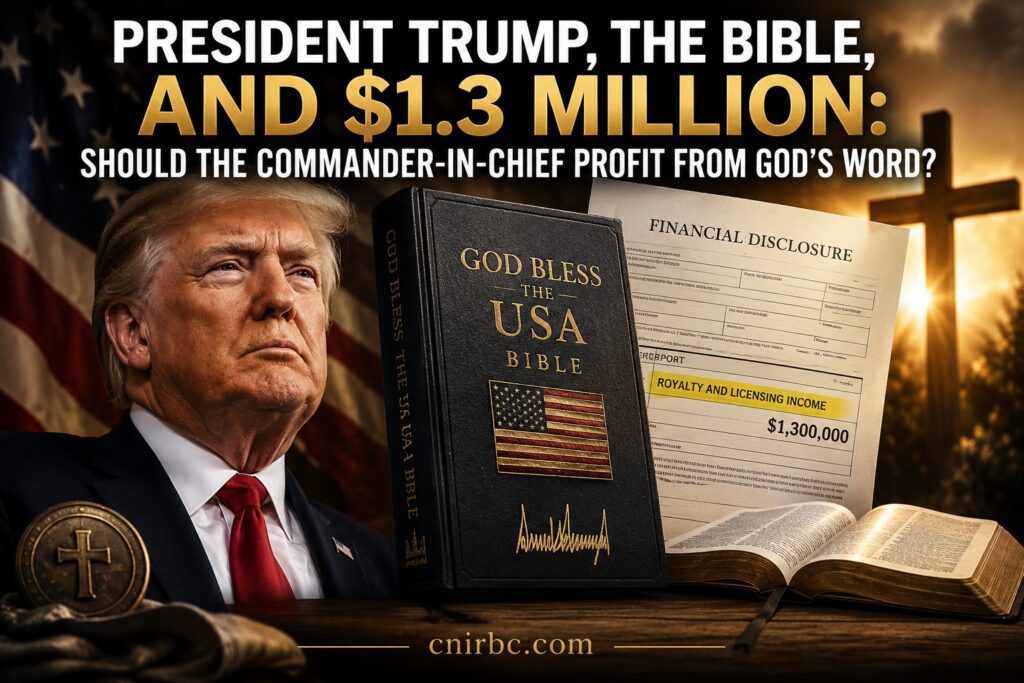
According to President Trump’s federal financial disclosure, President Trump reported approximately $1.3 million in royalty and licensing income connected to the God Bless the USA Bible, a patriotic edition that combines Scripture with America’s founding documents.
The disclosure has ignited one question Christians across America cannot easily dismiss:
Should President Trump personally earn money from a Bible?
Supporters argue there is nothing improper about President Trump’s arrangement. They note that President Trump licensed his name to the project and received royalties, much like authors, pastors, musicians, and publishers earn income from Christian books, study Bibles, devotionals, and other faith-based materials.
Others view the issue very differently.
Critics believe the controversy extends beyond politics or business. Their concern is that when President Trump receives personal royalty income from a Bible bearing his endorsement, the line between proclaiming God’s Word and commercializing it becomes increasingly difficult to distinguish.
For many believers, the discussion immediately turns to Scripture.
Jesus entered the Temple and drove out those buying and selling, declaring, “My house shall be called the house of prayer; but ye have made it a den of thieves” (Matthew 21:12-13, KJV). The Apostle Paul also warned against those who “corrupt” or “peddle the word of God” for personal gain (2 Corinthians 2:17).
To be clear, these passages address different historical settings than a modern commercial Bible sold in the marketplace. Even so, they raise enduring questions about the relationship between faith, commerce, and personal profit.
This story is about more than one financial disclosure.
It raises broader questions for the Church. Is there a biblical distinction between earning royalties from a Christian book and earning royalties from a Bible itself? Does attaching President Trump’s name to Scripture encourage more people to open God’s Word—or does it risk overshadowing the message with the messenger? Should any elected official, especially President Trump, personally benefit financially from a product centered on the Bible?
Christians will likely answer these questions differently.
But one fact remains undisputed: President Trump’s financial disclosure has placed this conversation before the nation. Whether viewed as a legitimate business arrangement or a matter of biblical ethics, the issue challenges believers to examine what Scripture teaches about stewardship, influence, and the handling of God’s Word.
In an era when faith and politics continue to intersect, perhaps the most important question is not whether President Trump could legally earn royalties from a Bible—but whether Christians believe President Trump should.