
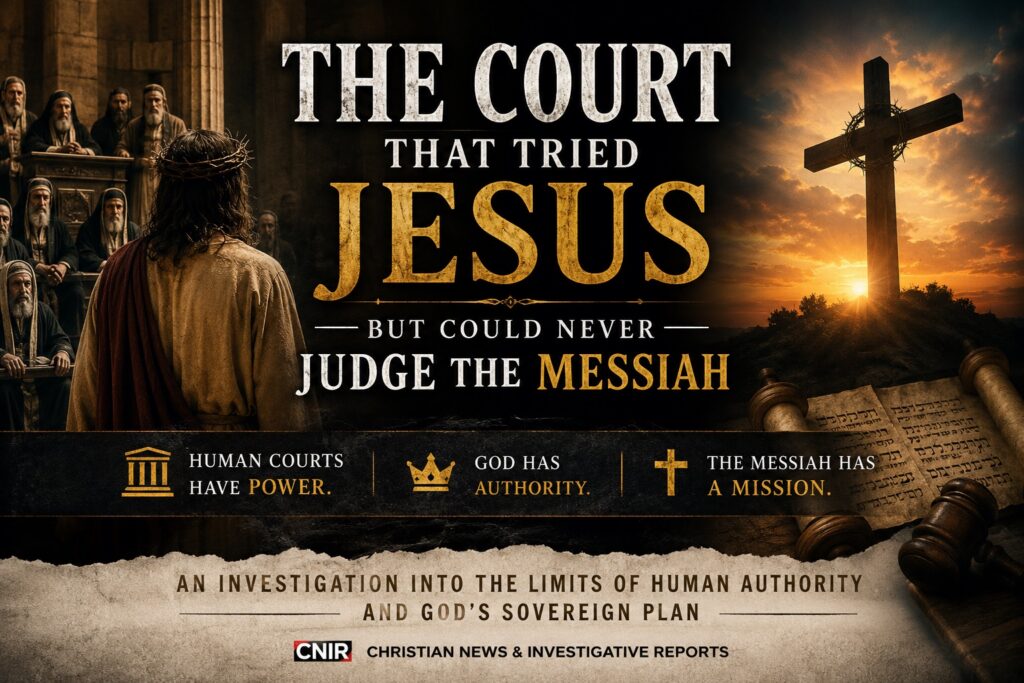
An Investigation into the Limits of Human Authority and God’s Sovereign Plan
By Christian News & Investigative Reports (CNIR)
cnirbc.com
🔎 The Question Few People Ever Ask
History remembers it as one of the most consequential trials ever conducted.
In the early hours before His crucifixion, Jesus of Nazareth stood before the Jewish religious leaders. Witnesses testified. The high priest questioned Him. The Sanhedrin reached its conclusion and delivered Him to the Roman governor, Pontius Pilate.
For centuries, Christians have studied the events surrounding that historic trial.
But there is another question—one that receives far less attention:
Did the Sanhedrin actually have the authority to judge the Messiah?
The answer reaches far beyond an ancient courtroom and into one of the Bible’s greatest themes: the limits of human authority when confronted with God’s sovereign plan.
🏛️ What Was the Sanhedrin?
The Sanhedrin was the highest religious and judicial council in first-century Judaism. Composed of chief priests, elders, and scribes, it served as Israel’s supreme legal body for interpreting the Law of Moses and resolving religious disputes.
Its responsibilities included hearing testimony, examining legal matters, and making judicial decisions concerning the Jewish community.
Although respected for its legal authority, the Sanhedrin operated under Roman rule, which significantly limited its governmental power, particularly in matters involving capital punishment.
Its authority was substantial—but it was never unlimited.
⚖️ The Trial That Changed History
According to the Gospel accounts, Jesus appeared before the Sanhedrin after His arrest in the Garden of Gethsemane.
Religious leaders questioned His teachings, examined witnesses, and ultimately accused Him of blasphemy after He affirmed His identity as the Messiah and the Son of God.
Following their proceedings, Jesus was taken before Pontius Pilate, since Roman approval was required to carry out a death sentence.
From a historical perspective, the Sanhedrin conducted a legal hearing.
From a biblical perspective, however, something much greater was unfolding.
📖 The Difference Between Trying Jesus and Judging the Messiah
This distinction is the heart of the investigation.
The Sanhedrin possessed the legal authority to question Jesus of Nazareth, the man standing before them.
What they did not possess was authority over God’s eternal purpose.
Throughout Scripture, the Messiah is never presented as someone commissioned by religious institutions or appointed by earthly governments.
Instead, the Bible consistently declares that the Messiah is sent by God Himself.
Daniel’s prophecy places the Messiah’s coming within God’s prophetic timetable (Daniel 9:24–27).
The Apostle Paul later writes:
“But when the fulness of the time was come, God sent forth his Son…” (Galatians 4:4, KJV)
In other words, no religious court could authorize His mission, revoke His calling, or determine the timing of His arrival.
Those decisions belonged exclusively to God.
👑 Authority Has Limits
One of the Bible’s recurring themes is that every earthly authority ultimately answers to a higher authority.
Governments rule.
Kings reign.
Courts issue judgments.
Religious leaders interpret laws.
Yet Scripture repeatedly teaches that God’s purposes cannot be overturned by human institutions.
Jesus Himself reminded Pontius Pilate:
“Thou couldest have no power at all against me, except it were given thee from above.” (John 19:11, KJV)
Those words reveal a profound truth.
Even while standing before judges, Jesus remained under the authority of His heavenly Father—not His earthly accusers.
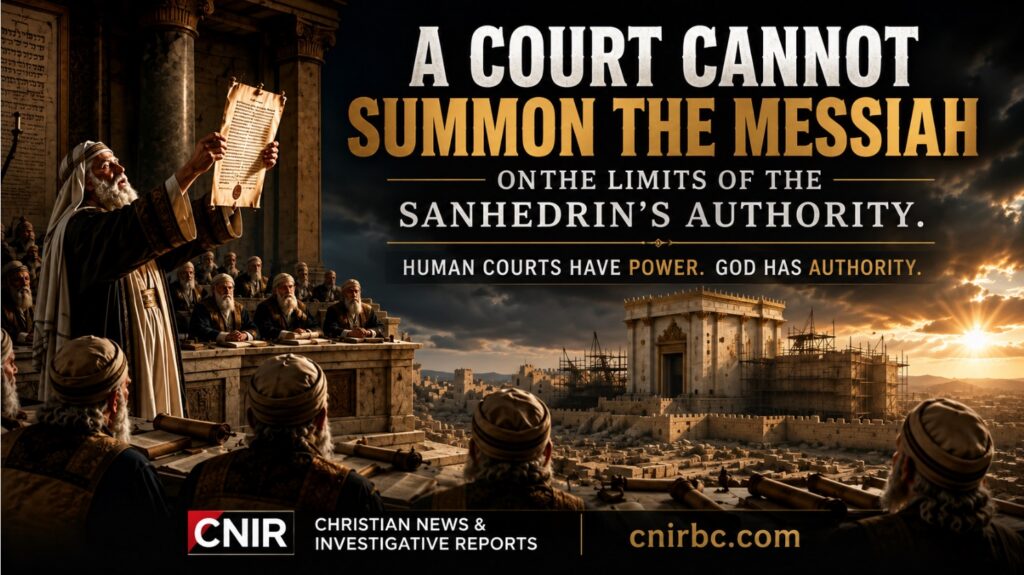
✡️ A Jewish Perspective
Traditional Judaism continues to await the coming of the Messiah and does not recognize Jesus as that promised Redeemer.
Even so, Jewish teaching generally understands that the Messiah’s appearance is determined by God rather than compelled through judicial authority.
While religious courts may examine claims, interpret Scripture, or render legal opinions, the arrival of the Messiah remains an act of divine providence rather than human legislation.
This point highlights an area of common understanding between Jewish and Christian thought regarding God’s ultimate authority over redemptive history.
🔍 CNIR Analysis
The historical trial of Jesus has been examined by theologians, historians, and legal scholars for generations.
Yet the deeper question is not simply whether the Sanhedrin placed Jesus on trial.
History clearly records that they did.
The more significant question is whether they possessed authority over the Messiah Himself.
The biblical record consistently answers that question by distinguishing between earthly jurisdiction and divine appointment.
The Sanhedrin could investigate.
They could interrogate.
They could render a legal verdict concerning the man before them.
What they could not do was place God’s eternal plan on trial.
The Messiah’s mission had already been established long before any witness entered the courtroom.
Long before Caiaphas questioned Jesus…
Long before Pilate washed his hands…
Long before Roman soldiers raised a cross…
God had already spoken through the prophets.
✝️ The Sovereignty of God on Display
Ironically, the very trial intended to condemn Jesus became one of the greatest demonstrations of God’s sovereignty.
What appeared to be a victory for His enemies became the fulfillment of prophecy.
Isaiah had foretold the suffering Servant.
David described the crucifixion centuries before Roman crucifixion existed.
Daniel announced the coming of Messiah according to God’s prophetic calendar.
The courtroom did not interrupt God’s plan.
It became part of it.
📌 Final Thought
The trial of Jesus reminds every generation that human authority has boundaries.
Courts can issue rulings.
Governments can pass laws.
Religious leaders can render opinions.
But no earthly institution possesses authority over God’s eternal purposes.
The Sanhedrin tried Jesus.
History records their verdict.
But according to Scripture, they could never judge the Messiah.
That authority belonged—and still belongs—to God alone.
Sources & Further Reading
- The Times of Israel Blogs – A Court Cannot Summon the Messiah: On the Limits of the Sanhedrin’s Authority
https://blogs.timesofisrael.com/a-court-cannot-summon-the-messiah-on-the-limits-of-the-sanhedrins-authority/ - Charisma Magazine – Sanhedrin Issues Historic Ruling Calling to Heaven for Messiah and Third Temple
https://mycharisma.com/propheticrevival/sanhedrin-issues-historic-ruling-calling-to-heaven-for-messiah-and-third-temple/
Editorial Note: This article examines historical events, biblical texts, and theological perspectives. References to external publications are provided for additional context and do not necessarily represent the views of Christian News & Investigative Reports (CNIR). Readers are encouraged to compare all claims with Scripture and historical evidence.



No court could ever judge Jesus, they were fulling Bible prophecy bcuz no one could ever judge the “Messiah”