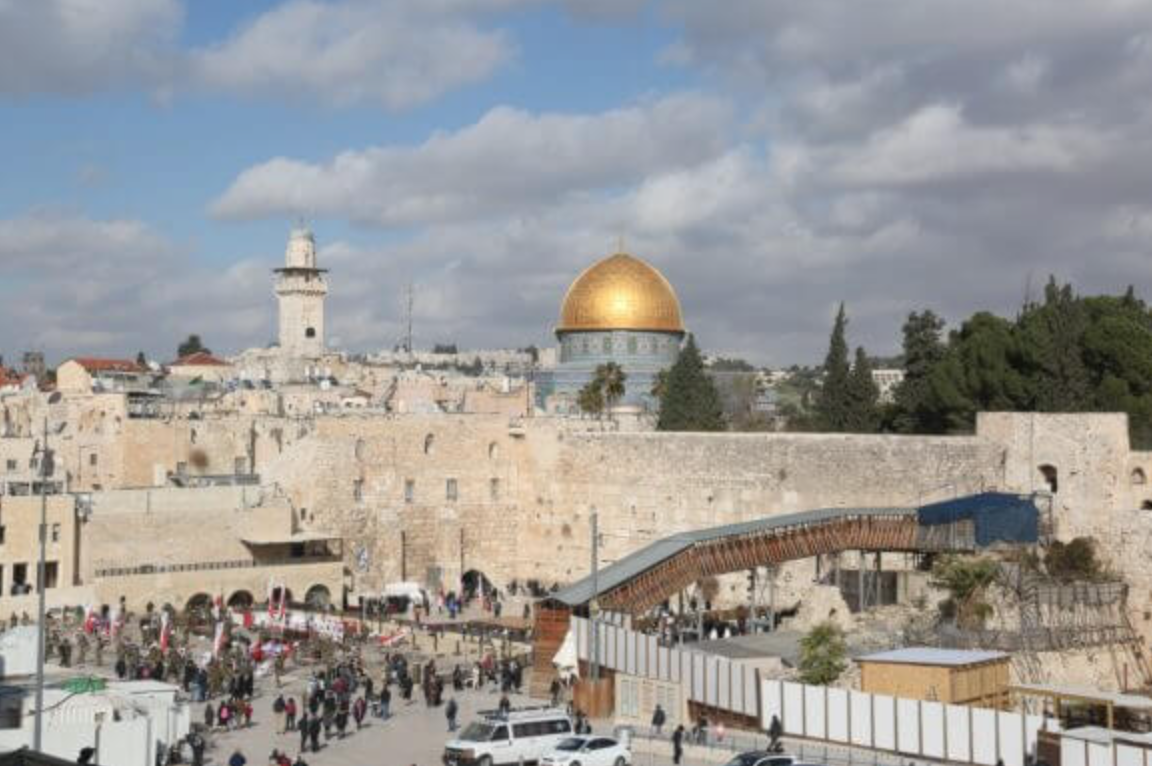
JERUSALEM — Discussions surrounding the possibility of a Third Jewish Temple often focus on biblical prophecy. But a more immediate question stands at the center of the debate: What happens to the Dome of the Rock if a Third Temple is actually built on Jerusalem’s Temple Mount?
For the Temple Institute, a Jerusalem-based organization dedicated to researching and preparing for the rebuilding of the Jewish Temple, the answer is unusually direct.
The organization says the Temple Mount would first have to be cleared of the Dome of the Rock and the mosques before physical reconstruction of the Temple could begin.
That position raises one of the most consequential religious and geopolitical questions in Jerusalem.
The Temple Institute’s Position
On its official Frequently Asked Questions page, the Temple Institute addresses when reconstruction of the Holy Temple could begin.
The organization states:
“Geo-politically, the Temple Mount has to be cleared of the Dome of the Rock and the mosques…”
But an important distinction should be made.
The Institute does not present violent destruction of the Islamic structures as its proposed solution. Instead, it discusses the possibility of Muslims agreeing that the structures could be disassembled and reconstructed elsewhere, allowing the Temple Mount to become the location of a rebuilt Jewish Temple.
That remains an aspiration of the organization—not Israeli government policy and not an announced construction project.
There is currently no Third Temple under construction on the Temple Mount.
Why the Dome’s Location Matters
The Temple Institute’s position is directly connected to where it believes the ancient Temple stood.
Second Chronicles 3:1 states:
“Then Solomon began to build the house of the LORD at Jerusalem in mount Moriah…”
The Temple Mount is traditionally identified with Mount Moriah. Today, the Dome of the Rock occupies a prominent central location on that elevated platform.
More significantly, the Temple Institute associates the Dome’s location with the site of the ancient Holy of Holies.
In historical material describing Temple Institute founder Rabbi Yisrael Ariel’s presence on the Temple Mount following Israel’s capture of the Old City in 1967, the organization refers to the Dome of the Rock as being at the “site of the Holy of Holies in the Holy Temple.”
If that identification is correct, the problem becomes obvious.
The Dome would occupy territory the Institute considers essential to rebuilding the Temple according to its historic location.
But Is That Location Certain?
This is where the investigation becomes more complicated.
The precise location of the ancient Temple and Holy of Holies cannot simply be established through unrestricted modern archaeological excavation beneath the Temple Mount. Religious sensitivities and political realities severely restrict archaeological investigation of the sacred platform.
Different theories concerning the ancient Temple’s precise footprint have therefore developed.
Some researchers have proposed locations north or south of the Dome of the Rock. Those theories have fueled speculation that a future Temple might somehow coexist with existing Islamic structures.
The Temple Institute, however, does not build its reconstruction program around such a coexistence theory.
Even within Jewish scholarship, identification of the exposed rock beneath the Dome with the ancient Foundation Stone has not been universally accepted.
That distinction is important: tradition, archaeological reconstruction and established archaeological fact are not necessarily the same thing.
Preparing for a Temple That Does Not Yet Exist
The Temple Institute’s activities extend beyond discussing the Temple.
The organization says it has spent decades researching Temple worship and reconstructing sacred vessels and priestly garments associated with Temple service.
It also says architectural planning for a future Temple has been undertaken.
One particularly significant project involves preparations associated with the altar. The Institute has stated that components of a stone altar have been prepared so they could eventually be transported to the Temple Mount if circumstances allowed.
For the organization, therefore, rebuilding the Temple is not merely an abstract theological subject.
It is a religious objective for which preparations are being made.
The Political Reality
Any attempt to remove, relocate or significantly alter the Dome of the Rock or Al-Aqsa Mosque would have consequences extending far beyond Israel.
The Temple Mount—known to Muslims as Haram al-Sharif—is sacred to Jews, Muslims and Christians and remains one of the most politically sensitive religious locations in the world.
Jordan maintains a historic custodial role concerning the Muslim holy sites in Jerusalem, while Israeli authorities maintain security control over access to the compound.
Any fundamental change to the existing arrangement could provoke intense opposition throughout the Muslim world and potentially create a major international crisis.
That makes the question of a Third Temple simultaneously religious, archaeological and geopolitical.
Why Christians Are Watching
For many Christians who hold a futurist interpretation of biblical prophecy, the possibility of another Jewish Temple carries enormous significance.
Daniel 9:27 describes sacrifice and oblation being stopped.
Jesus points His disciples toward Daniel’s prophecy in Matthew 24:15:
“When ye therefore shall see the abomination of desolation, spoken of by Daniel the prophet…”
Second Thessalonians 2:4 describes the man of sin as one who “sitteth in the temple of God, shewing himself that he is God.”
Revelation 11:1 also describes John being instructed:
“Rise, and measure the temple of God, and the altar, and them that worship therein.”
These passages have led many futurist Christian interpreters to anticipate some form of restored Temple worship before or during the events surrounding the Tribulation.
But Scripture does not explain the modern political process through which such a Temple would emerge.
That unanswered question is precisely what makes developments surrounding the Temple Mount so closely watched.
Prophecy, Preparation and Speculation
Three things should remain separate.
Biblical prophecy: Several passages are interpreted by futurist Christians as anticipating a future Temple and renewed sacrifice.
Documented preparation: The Temple Institute openly advocates rebuilding the Temple and has undertaken preparations connected with that goal.
Speculation: How political circumstances could change, whether the Dome of the Rock would actually be relocated, and when—or whether—a Third Temple will ultimately be constructed cannot presently be established.
The Temple Institute’s position nevertheless provides an important window into what at least one prominent Third Temple organization believes would have to occur.
For the Institute, the question is apparently not whether a Third Temple should eventually stand on Mount Moriah.
The question is how the religious and geopolitical obstacles preventing its construction will ever be removed.
And towering above that question—literally and symbolically—is the Dome of the Rock.
Editorial Note
This article is intended to encourage biblical discussion—not to criticize any individual pastor, church, or denomination. CNIR affirms that Scripture honors faithful spiritual leaders while also emphasizing the importance of mentoring and preparing the next generation. Our hope is that this conversation inspires churches to remain biblically faithful, spiritually healthy, and ready for the future. This article was created with AI assistance and curated by CNIR Staff for accuracy and editorial standards. Source: Christian News & Investigative Reports (CNIR) — cnirbc.com