Noah’s Ark at Durupınar? What the New Scans and Drilling Actually Reveal
CNIR — Christian News & Investigative Reports

TURKEY — New radar scans, deep-core drilling and hundreds of soil samples from Turkey’s mysterious Durupınar formation are once again raising a question that has fascinated researchers and Christians for decades: Could the remains of Noah’s Ark actually be buried beneath this boat-shaped formation?
The answer remains unproven—but the latest evidence deserves careful examination.
A Remarkable Biblical Measurement
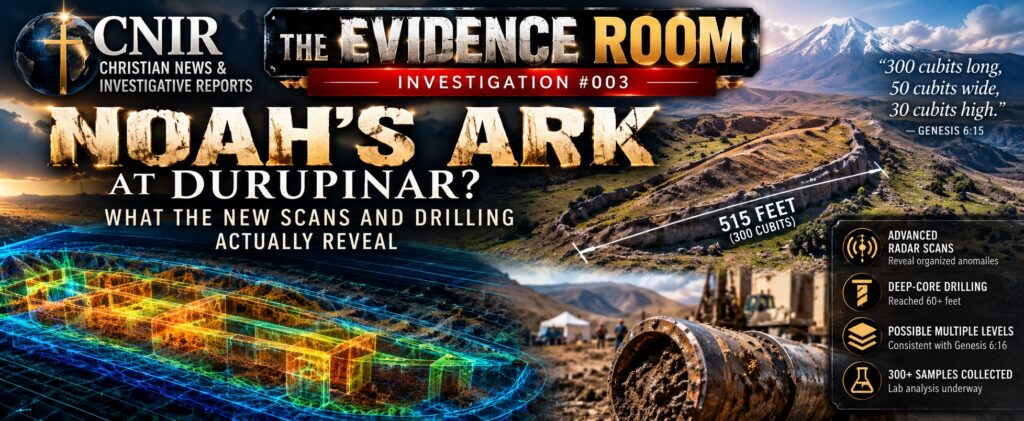
Genesis 6:15 records God’s instructions to Noah: the Ark was to measure 300 cubits long, 50 cubits wide and 30 cubits high.
The Durupınar formation is commonly reported at approximately 157 meters, or 515 feet, long. Using an Egyptian royal cubit of approximately 20.6 inches, 300 cubits calculates to roughly 515 feet—a striking correspondence with the formation’s reported length. The Noah’s Ark Scans project highlights this measurement as part of its case.
However, CNIR found that claims that Durupınar “precisely matches” all three biblical dimensions are overstated. The length provides the strongest correspondence. The formation’s present width does not precisely equal 50 royal cubits, and researchers have not demonstrated a surviving height precisely corresponding to the biblical 30 cubits.
What Did the Radar Actually Find?
The 2026 investigation has produced some of its most intriguing findings underground.
Researchers using advanced three-dimensional radar report detecting angular structures, a central corridor and organized spaces extending toward the center of the formation. Some interpretations describe features arranged across what appear to be three underground levels—an intriguing detail because Genesis 6:16 describes Noah’s Ark as having lower, second and third levels.
More recent analysis has gone further.
Dr. Khosrow Bakhtar, developer of the radar technology used during the investigation, said preliminary imagery revealed organized structural patterns rather than what he expected from a solid geological mass. The research organization has characterized these results as evidence of a possible man-made structure.
That conclusion, however, remains preliminary and has not yet been established through peer-reviewed archaeological publication.
Radar can reveal anomalies, boundaries, voids and differences beneath the ground. It cannot by itself tell researchers, “This is Noah’s Ark.”

Scientists Have Now Drilled Into the Formation
The investigation took another major step during the 2026 field season: researchers actually drilled deep beneath Durupınar.
More than 300 samples were collected from different depths inside and outside the formation. Some drilling reached approximately 20 meters—more than 60 feet underground. Researchers reported that drilling at more than a dozen locations did not encounter the solid bedrock they expected. Instead, cores contained soil, boulders and unusually dark soil deposits.
Earlier sampling had already found approximately three times more organic material inside the formation, along with elevated potassium and differences in pH compared with surrounding samples. Researchers are investigating whether those differences could be associated with decomposed ancient wood or whether they have an entirely natural geological explanation.
What Has NOT Been Proven
This distinction is critical.
Researchers have not announced the recovery of identifiable wooden beams from Noah’s Ark.
They have not recovered ancient shipbuilding joints, recognizable decks or other artifacts that independently establish the existence of a giant wooden vessel.
A drill bit reportedly broke after encountering an extremely hard layer several meters underground, prompting speculation that the material could be mineralized or petrified wood. But that identification has not been scientifically confirmed.
And despite recent headlines, the longstanding geological argument has not disappeared. Previous geological research concluded that Durupınar was a natural rock formation. The new drilling is significant precisely because researchers are now attempting to test that explanation with physical samples rather than relying solely on the site’s unusual appearance.
The Evidence Room Verdict
At this point, CNIR finds several facts genuinely worthy of attention.
Durupınar is unmistakably boat-shaped. Its approximately 515-foot reported length corresponds remarkably closely to 300 Egyptian royal cubits. Radar has detected organized-looking subsurface anomalies, including angular features, corridor-like patterns and possible multiple levels. Researchers have also reported significant differences between soil collected inside and outside the formation.
But none of those findings individually—or collectively—currently proves that Durupınar is Noah’s Ark.
The most important evidence may still be sitting inside laboratory sample containers.
Researchers say the newly recovered cores are undergoing analysis to determine their composition and whether they contain evidence consistent with human activity or decomposed wood. A more complete scientific report is expected in 2027, with one Turkish report indicating April or May as the anticipated timeframe.
If laboratory testing eventually identifies worked ancient timber, artificial construction materials or unmistakable archaeological evidence of a massive wooden structure, the Durupınar investigation would enter an entirely different stage.
Until then, the evidence is intriguing—but the verdict remains open.
THE EVIDENCE ROOM — INVESTIGATION #003
CNIR follows the evidence wherever it leads.
Disclaimer: The information presented in this article is for informational and educational purposes only. Readers are advised to conduct thorough research before making any decisions. Source: Christian News & Investigative Reports (CNIR) — cnirbc.com Reporting the headline. Investigating the facts